For decades, most companies have operated under a linear economic model: extract resources, manufacture products, sell them, and dispose of them after use. This “take–make–waste” model has driven economic growth but also created significant environmental challenges, including resource depletion, material waste, and rising carbon emissions.
A circular business model offers an alternative. Instead of treating products as disposable assets, circular models aim to keep products, materials, and resources in use for as long as possible. Companies design products for durability, repair, reuse, and recovery, while creating new ways to deliver value to customers.
- Circular Business Models – At a Glance
- What Is a Circular Business Model?
- Types of Circular Business Models
- The Business Case for Going Circular
- Challenges in Making the Transition
- The Role of Digital Technology
- Frequently Asked Questions
Circular Business Models – At a Glance
-
Concept origin: Circular business models derive from economist Walter Stahel's 1970s concept of an "economy in loops" — focused on extending product life and preventing waste.
-
Modern framework: The Ellen MacArthur Foundation brought the idea into mainstream business strategy in the 2010s, defining a circular economy as a system that keeps products and materials in use at their highest value.
-
Role in the circular economy: Circular business models are the commercial engine of the circular economy — redesigning how companies create, deliver, and capture value while reducing resource inputs and waste.
-
Core idea: Instead of "take–make–waste," circular models close, slow, or narrow material loops through repair, reuse, remanufacturing, and recycling.
-
Value creation logic: By keeping products and materials circulating through multiple lifecycles, circular models recover value that the linear economy simply discards.
-
Typical mechanisms: Product-as-a-service, life extension programs, sharing platforms, reverse logistics, and closed-loop material systems.
-
Strategic drivers: Material scarcity, rising resource costs, sustainability regulation, and supply chain risk are pushing companies toward circular strategies.
-
Operational requirement: Circular models depend on supply chain collaboration, lifecycle data transparency, and reverse logistics systems that can reliably recover products and materials.
What Is a Circular Business Model?
A circular business model is a strategy designed to keep products, components, and materials in use for as long as possible. Instead of treating waste as an unavoidable outcome of production and consumption, circular models aim to eliminate it from the system entirely. They do this through durable product design, closed-loop supply chains, reverse logistics, and service-based offerings that incentivize longevity rather than disposability.
The concept builds on three core principles popularized by the Ellen MacArthur Foundation: design out waste and pollution, keep products and materials in use, and regenerate natural systems. In practice, this means rethinking not only how products are manufactured, but also how they are delivered to customers, maintained during use, and recovered at the end of their lifecycle.
Importantly, circular business models are not just about sustainability. They are part of a broader transition toward a circular economy that integrates sustainability into business strategy. They represent a commercial strategy that can reduce input costs, generate recurring revenue streams, strengthen customer relationships, and unlock new market opportunities.
Design frameworks such as Cradle-to-Cradle provide practical guidance for implementing these principles at product level.
Types of Circular Business Models
Circular strategies take many different forms, and companies rarely rely on a single model. Most organizations combine several approaches depending on their industry, product complexity, and customer base.
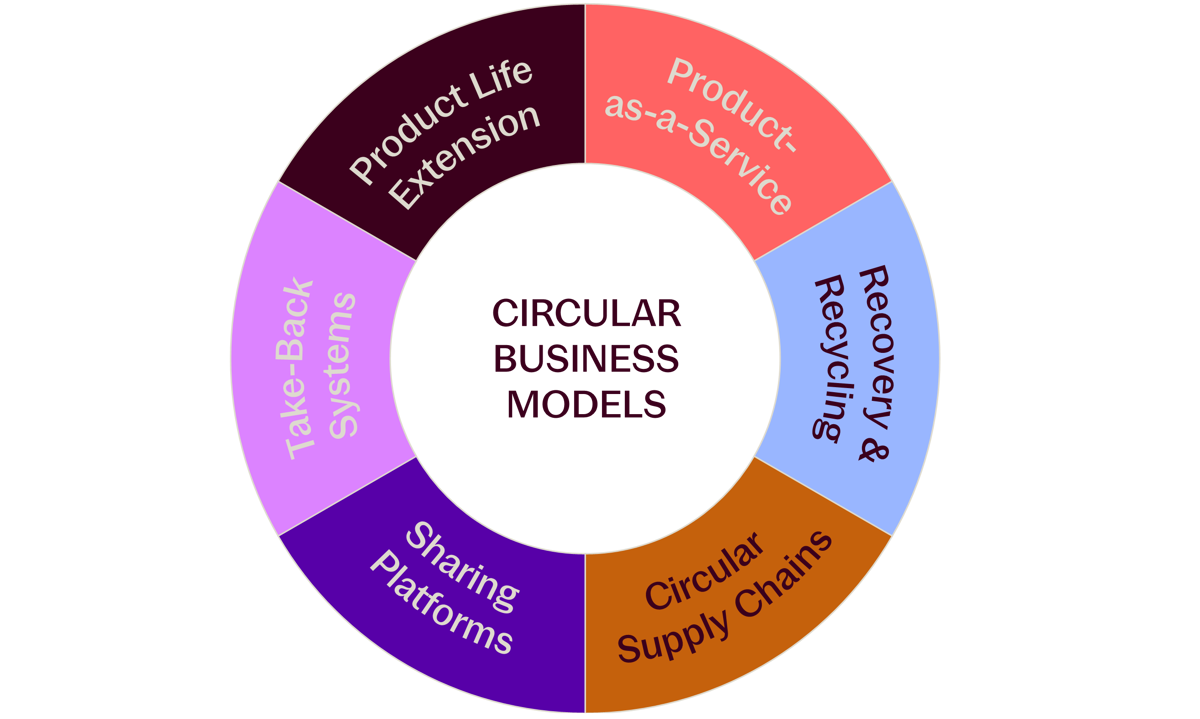
Consulting firm Accenture has developed one of the most widely cited frameworks, identifying five primary circular business models: Circular Supply Chain, Sharing Platform, Product-as-a-Service, Product Life Extension, and Recovery & Recycling. Together, these models describe how companies can create economic value while reducing resource consumption and waste.
1. Circular Supply Chain
Circular supply chains replace virgin raw materials with renewable, recycled, or bio-based inputs. By integrating secondary materials into production processes, companies reduce their dependence on finite resources while improving resilience against supply disruptions and commodity price volatility.
This model often requires greater transparency across suppliers and materials, enabling companies to track resource flows throughout the supply chain. In some cases, manufacturers also participate in industrial symbiosis networks, where waste from one production process becomes a valuable input for another.
2. Sharing Platform
Sharing platforms increase the utilization rate of products that would otherwise remain underused. Instead of individual ownership, multiple users access the same asset through digital platforms that coordinate availability and usage.
This model is particularly effective for high-value assets that are used infrequently, such as vehicles, machinery, or specialized equipment. By maximizing capacity use, sharing platforms reduce the number of products required to deliver the same service across a population.
3. Product-as-a-Service
In a product-as-a-service model, companies retain ownership of a product while customers pay for its performance or usage. Instead of selling the asset itself, the provider delivers an outcome.
This fundamentally aligns incentives between manufacturer and customer. Because the producer remains responsible for maintenance and end-of-life recovery, there is a strong incentive to design products that are durable, repairable, and resource-efficient.
Examples include Michelin’s tire-as-a-service offering for fleet operators or Philips’ lighting-as-a-service model for commercial buildings.
4. Product Life Extension
Product life extension models aim to keep products in use longer through repair, refurbishment, upgrades, and remanufacturing.
This approach preserves the value embedded in components and materials while reducing the need for new production. Industrial equipment manufacturers frequently remanufacture engines, machinery, and components to original specifications, delivering performance comparable to new products at significantly lower cost and environmental impact.
Consumer brands have also embraced this model. Outdoor apparel company Patagonia, for example, promotes repair services and resale programs that extend the lifetime of its products.
5. Recovery and Recycling
Recovery and recycling models focus on capturing value from products at the end of their lifecycle. Through take-back programs, deposit schemes, and advanced recycling technologies, companies recover materials that can be reintegrated into new production cycles.
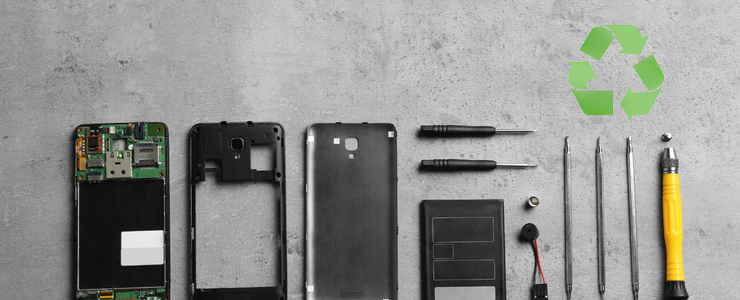
Closed-loop recycling systems are increasingly used in industries such as electronics, automotive, and packaging. For example, Apple’s Daisy robot disassembles returned iPhones to recover valuable materials, while automotive manufacturers recover metals and components from end-of-life vehicles.
Beyond the five models identified by Accenture, researchers and practitioners often highlight additional approaches that complement circular strategies.
Resale and Secondary Markets
Companies increasingly participate directly in resale markets, enabling products to move through multiple ownership cycles. Brands may operate certified resale platforms or take-back-and-resell programs that extend product lifetimes while generating additional revenue.
Industrial Symbiosis
In industrial symbiosis networks, waste or by-products from one company become inputs for another. This systems-level approach creates circular industrial ecosystems where energy, water, and materials circulate between facilities, reducing waste and costs for all participants.
The Business Case for Going Circular
Circular models are not altruistic commitments — they have a clear commercial rationale. Companies that reduce their dependence on virgin raw materials are less exposed to supply disruptions and price spikes. Those that sell services rather than products generate more predictable recurring revenue. Those that design for longevity and recovery often find that premium positioning follows naturally.
There is also a regulatory dimension that will only grow in importance. The EU's Circular Economy Action Plan, Ecodesign Regulation, and Corporate Sustainability Reporting Directive are creating a compliance floor that raises the cost of staying linear. Companies that have already built circular capabilities will navigate that environment with less friction and expense than those that have not.
Customer expectations are shifting in the same direction. Across consumer and B2B markets, purchasing decisions increasingly factor in a company's environmental footprint. A circular model is not just an operational strategy — it is a brand asset.
Challenges in Making the Transition
Moving from a linear to a circular business model is genuinely difficult. It requires rethinking product design from the ground up, rebuilding logistics to handle reverse flows, and often restructuring revenue models — which can create short-term pain for long-term gain. A few specific challenges stand out:
-
Reverse logistics complexity. Getting used products back from customers in a cost-effective, organized way is harder than it sounds. It requires customer participation, collection infrastructure, and sorting capabilities that many companies have not built.
-
Data and traceability gaps. Circular models depend on knowing where materials are, what condition they're in, and when they'll return. Without digital product passports, IoT tracking, or robust ERP systems, this visibility is hard to achieve at scale.
-
Organizational inertia. Shifting to a service model or investing in take-back infrastructure challenges existing business units, metrics, and incentive structures. Cross-functional alignment is essential and rarely easy.
-
Consumer behavior. Even when customers say they value sustainability, getting them to actually return products, participate in resale schemes, or pay for access rather than ownership requires deliberate design and often meaningful incentives.
The Role of Digital Technology
Digital infrastructure is what makes circular business models scalable. Product lifecycle tracking, material flow data, and supply chain transparency are all prerequisites for effective circularity — and all require digital systems to manage at any meaningful volume.
Life cycle assessment (LCA) software enables companies to measure the environmental impact of their products across the full value chain, identify hotspots, and make design decisions that reduce material and energy inputs. Compliance platforms track material content and regulatory requirements across jurisdictions. And integrated sustainability data systems — connecting product design, procurement, operations, and reporting — provide the decision-making foundation that circular strategies require.
Without this digital backbone, circular models tend to remain pilot programs rather than becoming embedded in how a business operates.
Frequently Asked Questions
What's the difference between a circular and a linear business model?
A linear model follows a take–make–waste sequence: raw materials are extracted, transformed into products, sold, and eventually discarded. A circular model interrupts that sequence by designing products for durability, enabling reuse and repair, and recovering materials at end-of-life to feed back into production.
Which industries are leading in circular business models?
Automotive has been remanufacturing components for decades. Electronics companies are investing in modular design and take-back programs. Fashion is one of the fastest-growing sectors for resale and rental models. Construction and chemicals are experimenting with material-as-a-service and industrial symbiosis. No single industry has a monopoly — circular innovation is happening across the board.
How do circular business models generate revenue?
Revenue can come from service fees and subscriptions in product-as-a-service models, from resale margins in secondary markets, from reduced input costs when recycled materials replace virgin ones, and from performance or outcome-based contracts where the seller is paid for results rather than units sold.
Is circularity only relevant for large companies?
No. While large corporations often have the capital to invest in new systems at scale, many circular business model approaches are well-suited to smaller companies — especially repair and refurbishment services, local sharing platforms, and niche resale markets. The regulatory pressure driving adoption is also broadly applied, not limited by company size.
What data systems do companies need for circular models?
At minimum, companies need product lifecycle tracking (to know where materials are), material composition data (to enable effective sorting and recovery), and reverse logistics management (to coordinate returns). More sophisticated operations add digital product passports, IoT-enabled condition monitoring, and integrated LCA tools that connect design decisions to environmental outcomes.