

Scope 1, 2, and 3 emissions have become the global language of corporate climate reporting. Under frameworks such as the Corporate Sustainability Reporting Directive (CSRD), the UK's Streamlined Energy and Carbon Reporting (SECR), and emerging standards worldwide, companies are expected to disclose greenhouse gas (GHG) emissions across their entire value chain, not just in their own facilities.
For any organization pursuing net zero, understanding scope 1, 2, and 3 emissions is the starting point. It enables you to identify hotspots, prioritize reduction measures, and demonstrate to regulators, investors, and customers that your climate strategy is grounded in robust data rather than estimates.
This guide explains the GHG Protocol scope framework, provides practical examples for each scope, and shows how IPOINT supports corporate carbon accounting from data collection to CSRD-ready reporting.
- Scope 1, 2, and 3 Emissions – Key Facts at a Glance
- The Origins of the Scope Framework
- What Is Scope 1?
- What Is Scope 2?
- What Is Scope 3?
- Why Measure All Three Scopes?
- How to Measure Your Carbon Footprint
- Streamlining Carbon Accounting with IPOINT
- Reduction Strategies Across All Scopes
- Turning Carbon Accounting into Advantage
- Frequently Asked Questions
Scope 1, 2, and 3 Emissions – Key Facts at a Glance
-
Framework origin: The Greenhouse Gas Protocol (GHG Protocol) groups corporate emissions into three scopes to distinguish direct and indirect emissions along the value chain.
-
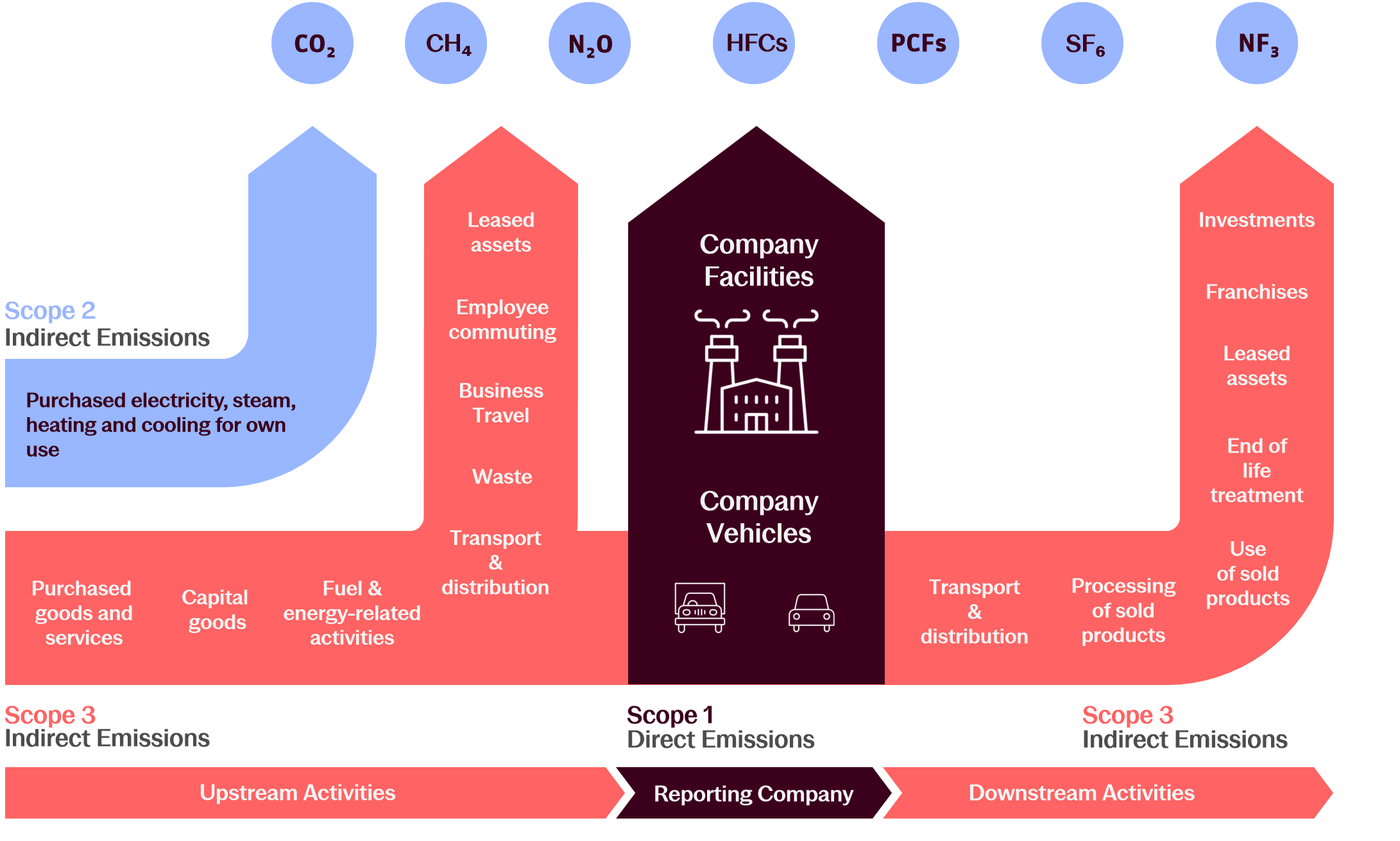
Scope definitions: Scope 1 covers direct emissions from sources a company owns or controls. Scope 2 covers indirect emissions from purchased energy. Scope 3 includes all other indirect emissions upstream and downstream.
-
Scope 3 dominance: For many companies, scope 3 emissions account for 70–90% of the total carbon footprint, making them critical for net zero strategies.
-
Regulatory expectation: Regulators and investors increasingly expect complete coverage of scope 1, 2, and 3 emissions as the basis for credible decarbonization plans.
The Origins of the Scope Framework
The scope 1, 2, and 3 concept originates from the Greenhouse Gas Protocol, developed by the World Resources Institute (WRI) and the World Business Council for Sustainable Development (WBCSD). First released in 2001, it created a common, internationally recognized method for companies to measure and manage their GHG emissions.
By distinguishing between direct and indirect emissions and introducing three scopes, the framework avoids double counting and provides a consistent basis for regulation, voluntary initiatives, and assurance. Today, it underpins key reporting regimes such as CSRD, SECR, and science-based target setting.
What Is Scope 1?
Scope 1 emissions are direct GHG emissions from sources that are owned or controlled by the company. They arise from activities where your organization directly burns fuel or releases greenhouse gases.
Typical scope 1 emission sources include:
-
Stationary combustion in boilers, furnaces, or combined heat and power plants
-
Mobile combustion in company-owned cars, trucks, forklifts, or construction machinery
-
Fugitive emissions from refrigerant leakage or gas infrastructure
-
Process emissions from chemical or physical processes in industries such as cement or steel
Because scope 1 emissions are under direct operational control, they are often easier to measure and reduce through efficiency improvements, fuel switching, or process optimization.
What Is Scope 2?
Scope 2 emissions are indirect GHG emissions from the generation of purchased or acquired electricity, steam, heating, or cooling consumed by the company. These emissions occur at the energy supplier's facilities, but they are driven by your demand for energy.
Key characteristics of scope 2 emissions:
-
Closely linked to your operational footprint but occurring off-site
-
Dependent on both energy consumption and the emission factors of the grid or supplier
-
Reported using two complementary methods: the location-based method uses the average emissions intensity of the regional grid; the market-based method uses contractual instruments such as renewable energy certificates (RECs), guarantees of origin, or power purchase agreements (PPAs)
Examples include electricity for production lines and data centers, purchased district heating for offices, or imported steam for industrial processes. Scope 2 reductions usually combine efficiency measures with a strategic shift to low-carbon or renewable energy.
What Is Scope 3?
Scope 3 emissions cover all other indirect GHG emissions that occur in a company's value chain, outside its direct control but linked to its activities. This includes both upstream (suppliers and inbound logistics) and downstream (customers, distribution, end-of-life) impacts.
For many sectors, scope 3 emissions represent the majority of the carbon footprint – often between 70 and 90%. They include, for example:
-
Emissions from extraction and processing of raw materials in purchased goods and services
-
Upstream transportation and distribution by third-party logistics providers
-
Business travel, employee commuting, and waste generated in operations
-
Use-phase energy consumption when customers operate your products
-
End-of-life treatment and recycling of products and packaging
To structure these value-chain emissions, the GHG Protocol defines 15 Scope 3 categories, grouped into eight upstream and seven downstream categories. Together, they provide a comprehensive view of how products and services create emissions before, during, and after they leave your facilities.
Because scope 3 emissions depend on supplier data, product design, and customer behavior, they are the most challenging to measure – but also offer the biggest levers for meaningful climate action.
For a deeper dive into CSRD and scope 3 requirements, see our dedicated blog article on CSRD & Scope 3.
Why Measure All Three Scopes?
Measuring only direct emissions no longer reflects how regulators, investors, and customers view climate risk. A complete carbon footprint scope 1, 2, 3 approach delivers:
-
A comprehensive view of climate impact: You see where greenhouse gas emissions really occur – often far beyond your own factory gates – and can focus on the most material GHG scope hotspots.
-
Regulatory compliance: CSRD requires companies to report material scope 1, 2, and 3 emissions in their sustainability statements. Other regimes, such as SECR in the UK, focus on scope 1 and 2 but increasingly expect relevant scope 3 transparency as best practice.
-
Science-based targets and net zero: Initiatives such as the Science Based Targets initiative (SBTi) require companies to include scope 3 emissions in their targets when these represent a significant share of the total footprint. Without robust scope 3 data, net zero scope 1, 2, 3 commitments lack credibility.
How to Measure Your Carbon Footprint
Setting up corporate carbon accounting across all three scopes typically follows these steps:
-
Define boundaries. Decide which entities and activities are included (e.g., based on operational control or equity share) and assign emission sources to the correct GHG Protocol scope.
-
Identify sources and Scope 3 categories. Map your operations and value chain to understand which scope 1, 2, and 3 emissions categories are relevant and likely to be material.
-
Collect activity data. Gather data on energy consumption, fuel use, purchased goods and services, logistics, business travel, and product use. Where primary data is missing, use recognized emission factors and high-quality secondary data (aligned with GHG Protocol / ISO 14064).
-
Calculate emissions. Apply GHG Protocol- or ISO 14064-compliant methodologies to convert activity data into CO₂e (carbon dioxide equivalents).
-
Analyze hotspots and improve over time. Identify major emission sources, validate data quality, and update your inventory regularly as data coverage and quality improve.
Streamlining Carbon Accounting with IPOINT
Manual spreadsheets and fragmented data quickly reach their limits when tracking GHG scope 1, 2, and 3 emissions. IPOINT's digital solutions help companies operationalize carbon accounting and meet growing regulatory expectations.
PCF Data Integration for Better Scope 3 Accuracy
By integrating Product Carbon Footprint (PCF) data, IPOINT goes beyond generic database averages. Primary data from suppliers and product models improves the quality of upstream scope 3 emissions, particularly for purchased goods, raw materials, and transportation and distribution.
Automation, Transparency, and Expert Support
IPOINT's carbon footprint software automates data collection from ERP, PLM, and supplier platforms, providing real-time insight into scope 1, 2, and 3 trends and enabling efficient carbon accounting & management.
In addition, IPOINT's sustainability consulting supports clients in designing carbon accounting frameworks, implementing standards such as GHG Protocol and ISO 14064, and translating results into actionable decarbonization roadmaps.
Corporate Carbon Footprint (CCF) for Scope 1, 2, and 3
Measure, manage, and report greenhouse gas emissions across all three scopes in line with the GHG Protocol. Central dashboards create transparency across sites and business units, while automated workflows support CSRD-compliant reporting and audit-ready documentation.

Reduction Strategies Across All Scopes
Once your scope 1, 2, and 3 emissions are quantified, the next step is targeted reduction:
-
Scope 1: Improve process and building efficiency, electrify heat and fleets where feasible, switch to lower-carbon fuels, and reduce fugitive emissions through leak detection and maintenance.
-
Scope 2: Implement energy management systems, invest in efficiency upgrades, and procure renewable energy via on-site generation, PPAs, or credible certificates.
-
Scope 3: Embed climate criteria in procurement, favor low-carbon materials and suppliers, redesign products for lower use-phase emissions and longer lifetimes, optimize logistics networks, and develop circular models to reduce end-of-life impacts.
A credible decarbonization roadmap combines reduction measures across all scopes and links them to clear targets, budgets, and responsibilities.
Turning Carbon Accounting into Advantage
Scope 1, 2, and 3 emissions accounting has moved from a niche sustainability topic to a strategic capability. Companies that understand their full greenhouse gas emissions profile can move from reactive compliance to proactive climate action.
By building a robust carbon footprint scope 1, 2, 3 inventory and leveraging digital tools such as IPOINT's carbon footprint solutions, organizations can meet regulatory requirements, support science-based targets, and create transparency for customers and investors. Comprehensive carbon accounting is not only the foundation of credible net zero strategies – it is a competitive advantage in a decarbonizing economy.
Frequently Asked Questions
What are Scope 1, 2, and 3 emissions?
Scope 1, 2, and 3 emissions are categories defined by the GHG Protocol to classify corporate greenhouse gas emissions. Scope 1 covers direct emissions from sources owned or controlled by the company, such as fuel combustion and process emissions. Scope 2 includes indirect emissions from purchased electricity, steam, heating, and cooling. Scope 3 covers all other indirect emissions along the value chain, both upstream and downstream.
Why is Scope 3 so important?
Scope 3 emissions often represent the majority of a company's total carbon footprint, especially in sectors with complex supply chains or high use-phase emissions. They capture the climate impact of purchased materials, logistics, product use, and end-of-life. Without addressing these scope 3 emissions categories, corporate net zero targets and science-based commitments remain incomplete.
What are the 15 Scope 3 categories?
The GHG Protocol defines 15 Scope 3 categories: eight upstream (purchased goods and services, capital goods, fuel- and energy-related activities, upstream transportation and distribution, waste generated in operations, business travel, employee commuting, upstream leased assets) and seven downstream (downstream transportation and distribution, processing of sold products, use of sold products, end-of-life treatment of sold products, downstream leased assets, franchises, investments).
How do I measure my company's carbon footprint?
Start by defining your organizational and operational boundaries and mapping scope 1, 2, and 3 emission sources. Collect activity data on energy use, fuel consumption, purchased goods and services, logistics, and product use. Then apply recognized standards such as the GHG Protocol or ISO 14064 to calculate emissions in CO₂e. Digital carbon accounting tools, like IPOINT's Corporate Carbon Footprint solutions, help automate calculations and generate audit-ready reports.
Is Scope 3 reporting mandatory?
Under CSRD and similar frameworks, companies must report material scope 1, 2, and 3 emissions. In practice, this means that if scope 3 emissions are significant – which is the case for most industries – they should be included in the sustainability report. Other regimes, such as SECR in the UK, focus formally on scope 1 and 2 but increasingly expect disclosure of relevant Scope 3 categories as stakeholder expectations evolve.
How can IPOINT help with carbon accounting?
IPOINT provides software and consulting to measure, manage, and report GHG scope 1, 2, 3 emissions. IPOINT integrates primary data from suppliers and internal systems, automates calculations, and delivers CSRD-ready reporting.