

When it comes to sustainability, all eyes are on the transport sector and the automotive industry in particular. The accelerating concern for climate change has thrust the concepts of sustainability, Environmental Social Governance (ESG) and Corporate Social Responsibility (CSR) into the forefront of the automotive landscape. As the wheels of progress turn, it becomes evident that measuring and mitigating the carbon footprint towards net-zero is not a choice for OEMs — it's an imperative.
- Sustainability in the Automotive Industry: Key Facts at a Glance
- 8 Challenges for Car Manufacturing Companies Regarding Sustainability
- 8 Sustainability Trends in the Automotive Industry
- Initiatives from Automotive Companies around the World
- Software Solutions for Sustainability
Sustainability in the Automotive Industry: Key Facts at a Glance
-
The automotive industry is one of the largest contributors to global CO₂ emissions — making sustainability a strategic imperative for every OEM, not an optional add-on.
-
The biggest challenges include supply chain complexity, carbon emissions, end-of-life vehicle management, and balancing eco-friendly practices with cost efficiency.
-
Key trends driving change are the electric vehicle revolution, circular economy practices, carbon-neutral manufacturing commitments, and digital transformation.
-
Leading automakers — including Volkswagen, Volvo, and Ford — have set carbon neutrality targets ranging from 2035 to 2050.
-
Integrated software solutions combining product compliance, lifecycle assessment (LCA), and carbon footprint data are essential to manage sustainability at scale across complex supply chains.
8 Challenges for Car Manufacturing Companies Regarding Sustainability
While the destination is clear — sustainable automotive practices — the path is fraught with challenges that demand innovative solutions car manufacturers have to tackle: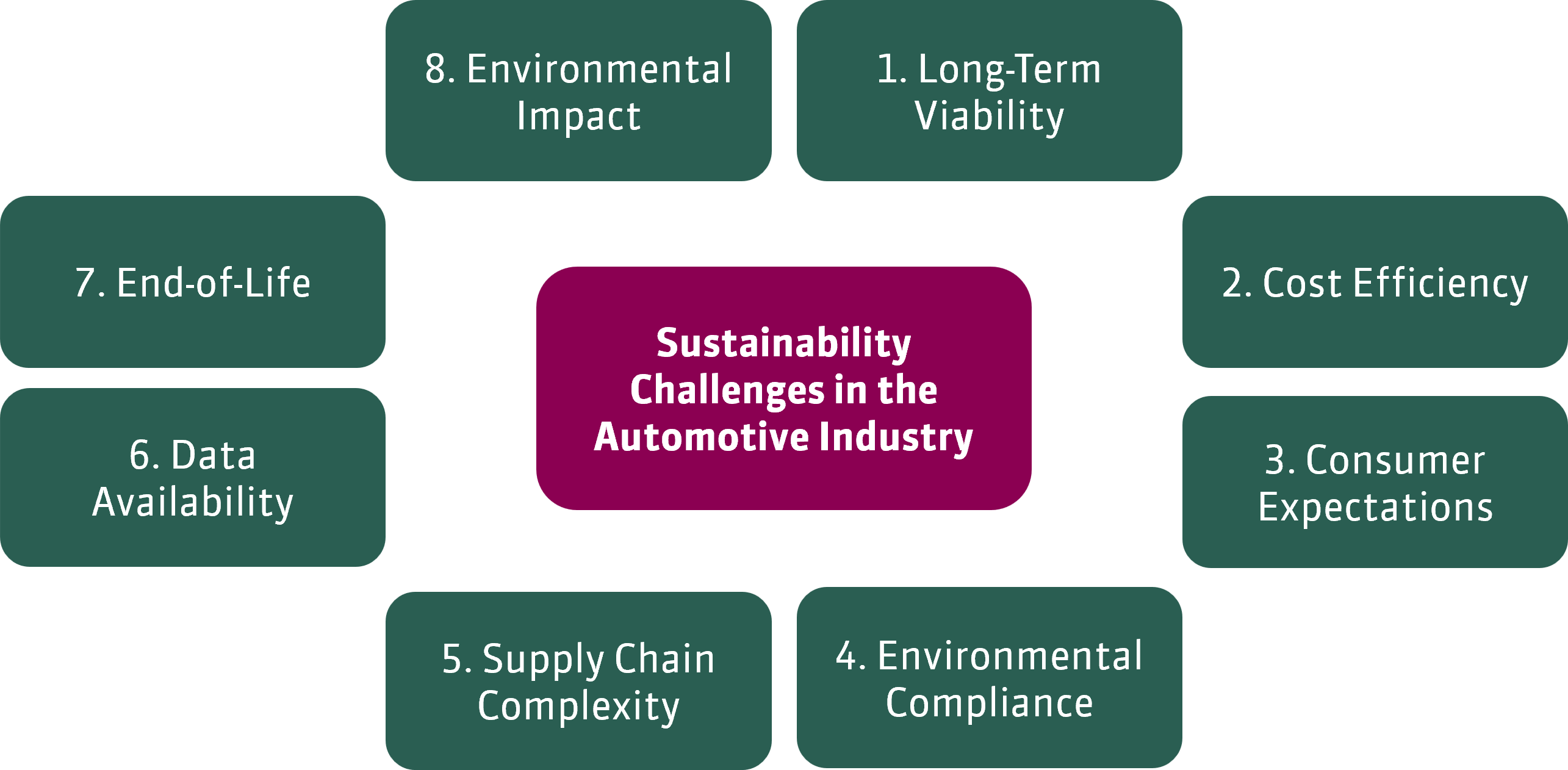
-
Strategic Planning for Long-Term Viability
Sustainability is not a one-time endeavor but a journey that demands continuous commitment. Car manufacturers grapple with the challenge of strategic planning for long-term sustainability while adapting to the evolving landscape of consumer preferences, technological advancements, and regulatory changes. Successfully overcoming these challenges involves a holistic approach that considers economic, environmental, and social factors.
-
Sustainability vs. Cost Efficiency
One of the tightrope walks that car manufacturers have to master is the trade-off between introducing sustainable practices and maintaining cost efficiency.The pursuit of eco-friendly initiatives often comes with an initial price tag. This also applies to the view of customers, who must be able to afford sustainably produced cars. However, sustainability and cost efficiency do not have to contradict each other. On the contrary, both companies and customers can benefit economically from more sustainable products, e.g. through savings in energy and material consumption.
-
Meeting Consumer Expectations
Consumers today are more environmentally conscious than ever, so car manufacturing companies face the challenge of aligning their sustainability goals with consumer expectations. It is important to communicate these efforts effectively to consumers. Building trust and loyalty requires transparency about sustainability initiatives, helping consumers feel confident in their choice of environmentally friendly vehicles.
-
Environmental Compliance and Risk Assessment
In an era of tightening environmental regulations, compliance in the automotive industry has become more critical than ever. Car manufacturers must navigate a constantly evolving landscape of standards, balancing the need for compliance with the drive for innovation to ensure that new, sustainably produced vehicles can be brought to market successfully.
-
Supply Chain Complexity
The complexity of automotive supply chains adds another layer to the sustainability challenge. From raw material extraction to the final assembly, the supply chain is rife with opportunities for improvement. OEMs must navigate intricate webs of suppliers, each with its own environmental impact, to create a more sustainable end-to-end process.
-
Data Availability and Quality
As mentioned above the automotive industry relies on complex supply chains that span multiple tiers of suppliers and involve a wide range of materials and components sourced from around the world. Gathering data on the environmental impact of each component, including factors such as raw material extraction, manufacturing processes, transportation, and end-of-life disposal, can be challenging due to the lack of transparency and standardized reporting across the supply chain.
-
End-of-Life Considerations
The lifespan of a car extends beyond its glory days on the road. The disposal of end-of-life vehicles poses a major challenge. Sustainable practices must encompass the recycling and responsible disposal of components, e.g. interior, ensuring that the environmental impact of a car's entire lifecycle is minimized.
-
Carbon Emissions and Environmental Impact
The most glaring challenge is the industry's carbon footprint. Traditional manufacturing processes, reliant on fossil fuels, contribute significantly to greenhouse gas emissions. Additionally, car manufacturing processes can release pollutants into the air, such as volatile organic compounds from painting and solvent use. Overall, many environmental impacts are associated with the automotive industry - both in production and in use - from water consumption, land use and habitat destruction to air and water pollution.
Automotive Sustainability Trend Study
Learn more about carbon reduction measures and targets in the automotive sector compared to other industries.

8 Sustainability Trends in the Automotive Industry
Various trends have emerged in the automotive industry to address these challenges shaping the landscape of sustainable car manufacturing and driving innovations. Here are some of the prominent trends and innovations defining the current sustainability strategy in the automotive sector:
-
Electric Vehicle Revolution
The rise of electric vehicles (EVs) is revolutionising the automotive sustainability landscape. Major automakers are investing heavily in the development of electric models, driven by the dual goals of reducing dependence on fossil fuels and mitigating greenhouse gas emissions. With advancements in battery technology, EVs are becoming more accessible, offering consumers a greener alternative to traditional internal combustion engines, as the carbon footprint of electric cars is lower overall across all life phases.
-
Hybrid Technologies
Hybrid vehicles, combining traditional internal combustion engines with electric propulsion, have gained prominence as a transitional step towards full electrification. Hybrid technologies offer improved fuel efficiency and reduced emissions, providing consumers with a sustainable option while maintaining the convenience of conventional fuel infrastructure.
-
Circular Economy Practices
By embracing the principles of the circular economy, car manufacturers are focusing on recycling, reusing and reducing waste throughout the production cycle. From using recycled materials in vehicle components to designing vehicles that are easier to disassemble for recycling, the industry is striving to minimize its environmental impact and promote resource efficiency in order to achieve a circular economy in the automotive industry.
-
Carbon Neutral Initiatives
Car manufacturers are committing to making their operations climate-neutral. This includes not only reducing the carbon footprint of car manufacturing, but also those from upstream processes in the supply chain and other downstream life cycle phases, such as distribution, use and end-of-life. The commitment to carbon neutrality and reduce CO2 emissions targeting net-zero aligns with global efforts to combat climate change and positions automotive companies as responsible stewards of the environment.
-
Smart and Sustainable Materials
The push for sustainability extends to the materials used in vehicle manufacturing. Companies are exploring alternative materials, such as bio-based plastics, recycled fabrics, and lightweight composites, to enhance fuel efficiency and decrease the environmental impact of production. The integration of smart materials that contribute to energy efficiency is also gaining traction.
-
Shared Mobility and Connectivity
The shift towards shared mobility models, such as ride-sharing and car-sharing services, is promoting a more efficient use of vehicles. By maximizing the lifespan and usage of individual cars, shared mobility contributes (at least in theory) to reducing the overall number of vehicles on the road and, consequently, their environmental impact. Additionally, connectivity features enable smart transportation systems, further enhancing efficiency and sustainability.
-
Regenerative Braking and Energy Recovery
Innovations in regenerative braking systems allow vehicles to recover and store energy during deceleration. This technology not only improves fuel efficiency in traditional vehicles but also enhances the overall energy efficiency of electric and hybrid vehicles. Regenerative braking is a critical component in the quest for sustainable and energy-efficient transportation solutions.
-
Digital Transformation
The digital transformation of the automotive industry is playing a pivotal role in sustainability efforts. From smart manufacturing processes to data-driven supply chain management, digitization is enhancing operational efficiency and reducing consumption of natural resources. Technologies like Artificial Intelligence (AI) and Internet of Things (IoT) or Digital Twins contribute to predictive maintenance, optimizing energy usage, and minimizing waste.
Initiatives from Automotive Companies around the World
Numerous car manufacturers around the world are demonstrating with their various initiatives how these challenges and trends can be implemented in practice:
Volkswagen's Journey to Sustainability
The VW Group has heavily invested in electric vehicle technology with its ID series. They are aiming to produce EVs at scale to reduce carbon emissions from transportation. Volkswagen has announced plans to make all of its manufacturing plants globally carbon neutral by 2050, focusing on renewable energy sources and energy efficiency improvements. Even if it is not widely known, Volkswagen was one of the first car manufacturers to carry out a life cycle assessment for one of its cars: the Golf III in 1996.
Volvo Cars' Commitment to Net Zero
Volvo has committed to becoming a fully electric car company by 2030, with plans to phase out internal combustion engine vehicles entirely. This development began in 2019, since when all models are available in an electrified version. Another milestone was the year 2023: with the launch of the EX90, EX30 and EM90 and the already existing EX40 and EC40, there are now 5 fully-electric models on the market.
Furthermore Volvo plans to reach 30 per cent average recycled content across its fleet, with new car models having at least 35 per cent recycled content. But that's not the end of the story, as Volvo also plans to become completely climate-neutral - net zero greenhouse gas emissions - and a circular business by 2040. IPOINT is proud to accompany and support Volvo Cars on this journey with our expertise and solutions.
Ford's Path to Responsible Manufacturing
The Ford Motor Company is also pursuing sustainability and has set itself high-level goals. In fact, Ford is planning to achieve complete carbon neutrality by 2050, and in Europe already by 2035. With the Mustang Mach-E, F-150 Lightning and the E-Transit, Ford has shown that a wide variety of car types can be electrified.
In addition, the topic of responsible sourcing and human rights is also important to Ford: it has entered into partnerships with the Initiative for Responsible Mining Assurance, the Responsible Supply Chain Initiative, Drive Sustainability and the Responsible Business Alliance to prioritize environmental and social responsibility across its supply chain.
Software Solutions for Sustainability

To drive sustainability in the automotive industry, companies need precise data, transparent insights, and smart digital tools. Measuring and managing climate and environmental impacts requires integrated software solutions that cover both compliance and sustainability.
From Product Compliance to Sustainability
Social and environmental compliance is increasingly converging with broader sustainability goals. From responsible sourcing and eco-design to manufacturing and end-of-life, companies need shared processes and tools to understand complex products and BOM structures. Combining product compliance software with LCA capabilities enables cross-functional teams to work with consistent, reliable data.
From Product to Corporate Carbon Footprint
In the automotive sector, climate responsibility starts with the product. As PCF and CCF boundaries overlap, companies need carbon footprint solutions that reflect both perspectives and integrate supply-chain data seamlessly.
Automation and Integration are Key
Manual PCF or LCA calculations are too time-consuming for today's challenges. With IPOINT Product Sustainability, environmental assessments can be automated and embedded into existing workflows, enabling faster, data-driven sustainability decisions.
Discover IPOINT Product Sustainability for the Automotive Industry
Benefit from a machine learning-based mapping of your production data with environmental data, such as ecoinvent or Carbon Minds, and a connection of material information from IMDS and BOMs.

With IPOINT as a partner, the vision of a greener, more eco-conscious automotive landscape comes into sharper focus, demonstrating that sustainability and efficiency can go hand in hand.
Frequently Asked Questions
What are the biggest sustainability challenges facing the automotive industry today?
The automotive industry faces a wide range of sustainability challenges, from reducing carbon emissions and meeting stricter environmental regulations to navigating complex global supply chains. Manufacturers must balance cost efficiency with climate goals, improve data quality across multi-tier suppliers, and address end-of-life impacts such as recycling and material recovery. Additionally, pressure from consumers, regulators, and ESG frameworks requires greater transparency and continuous improvement across all lifecycle stages of a vehicle.
How is the shift to electric and hybrid vehicles shaping automotive sustainability?
Electric vehicles (EVs) and hybrid technologies are central to reducing greenhouse gas emissions in the transport sector. EVs cut tailpipe emissions to zero and generally offer lower total lifecycle emissions compared to internal combustion engine vehicles. Hybrid vehicles provide a transition step by improving fuel efficiency and reducing CO₂ output. Advancements in battery technology, renewable energy use, and recycling of battery materials further enhance the environmental performance of EVs and support long-term climate targets.
How can digital transformation support sustainability in the automotive sector?
Digital transformation enables manufacturers to optimize environmental performance across the entire vehicle lifecycle. Technologies such as AI, IoT, digital twins, and data-driven supply chain platforms help reduce energy consumption, increase manufacturing efficiency, and improve visibility into complex supplier networks. Integrated software solutions that combine product compliance data, lifecycle assessments (LCA), and carbon footprint calculations support faster, more reliable decisions — helping automotive companies meet ESG goals and regulatory requirements while staying competitive.
Why are PCF and lifecycle data becoming essential for sustainability in the automotive industry?
Product Carbon Footprints (PCFs) and lifecycle data are now central to sustainability because OEMs must demonstrate measurable progress toward CO₂ reduction and net-zero targets. As regulations tighten and ESG reporting expands, manufacturers need traceable, comparable and standardized GHG data across the entire vehicle lifecycle — from raw materials to end-of-life. With IMDS 15 supporting the exchange of PCF information aligned to the Catena-X PCF Rulebook, PCF reporting is evolving from optional sustainability disclosure to an operational requirement across the automotive supply chain.
How does IMDS 15 influence sustainability reporting for OEMs and suppliers?
IMDS 15 introduces a standardized way to exchange PCF and Global Warming Potential (GWP) data within the existing material data workflow. For suppliers, this means that PCF reporting becomes part of the same system they already use for material and compliance declarations. For OEMs, it unlocks higher-quality, comparable PCF datasets across thousands of components and multi-tier suppliers. This integration strengthens supply-chain transparency, reduces manual reporting efforts, and helps automotive companies meet EU regulations, voluntary climate targets, and Catena-X data quality requirements.
How can digital tools support PCF calculation, LCA automation, and sustainability goals in the automotive sector?
Digital solutions such as IPOINT Product Sustainability play a key role in enabling PCF and LCA calculations at scale. Modern sustainability platforms integrate BOM data, material databases, supplier information, and Catena-X aligned PCF methods — reducing manual work and improving data accuracy. IMDS connectivity, machine-learning-based data mapping, and automated lifecycle modeling help OEMs and suppliers manage emissions across product portfolios, assess reduction potentials, and comply with emerging regulatory frameworks. By embedding these workflows into design, sourcing, and compliance processes, automotive companies can reduce environmental impacts while strengthening operational efficiency.
What does it mean to be green in the automotive industry?
Being green in the automotive industry means reducing environmental impact across the entire vehicle lifecycle — from sustainable manufacturing and responsible sourcing to minimizing carbon emissions and ensuring proper end-of-life recycling. It encompasses the transition to electric vehicles, the adoption of circular economy practices, the use of sustainable materials, and setting measurable targets for carbon neutrality. Transparency toward consumers, regulators, and investors is equally essential, as ESG reporting increasingly requires verifiable evidence of environmental progress.
What is a carbon neutral car?
A carbon neutral car is a vehicle whose entire lifecycle — from raw material extraction and manufacturing to use and end-of-life disposal — generates net-zero greenhouse gas emissions. This is achieved by minimizing direct emissions through electrification and efficient production processes, and by offsetting any remaining emissions. Leading automakers such as Volvo and Volkswagen have committed to producing carbon neutral vehicles and operating carbon neutral facilities within the coming decades, reflecting the industry's broader push toward net-zero.
How does supply chain transparency contribute to automotive sustainability?
Automotive supply chains span multiple tiers of global suppliers, each with its own environmental footprint. Without clear visibility into raw material sourcing, manufacturing processes, and transportation impacts, OEMs cannot accurately measure or reduce their overall carbon footprint. Standardized data exchange — for example through IMDS and emerging frameworks like Catena-X — helps manufacturers identify emission hotspots, enforce responsible sourcing standards, and meet ESG reporting requirements with traceable, high-quality data.
What role do circular economy practices play in sustainable car manufacturing?
Circular economy practices are central to reducing the automotive industry's resource consumption and environmental impact. By designing vehicles for disassembly, incorporating recycled and recyclable materials, and minimizing waste throughout the production cycle, manufacturers can significantly cut emissions and improve material efficiency. Volvo, for example, targets at least 35% recycled content in new car models — demonstrating how circular principles can be embedded into vehicle development strategies and contribute to long-term climate goals.