
California Proposition 65 is more than just a U.S. regulation. It affects any company that places products on the California market – no matter where they're based. With stricter labeling rules coming into effect in 2025, businesses must reassess their compliance strategy to avoid penalties and protect their reputation. This article explains what Prop 65 is, why it matters for international companies, and how to stay compliant in a fast-changing regulatory landscape.
- California Proposition 65 – Key Facts at a Glance
- What Is California Proposition 65?
- Inside the Proposition 65 List
- Who Must Comply with California Proposition 65?
- When and How to Provide a California Proposition 65 Warning
- How to Stay Compliant with Cal Prop 65
- How IPOINT Supports California Proposition 65 Compliance
California Proposition 65 – Key Facts at a Glance
-
Global reach: California Proposition 65 applies to any business selling products in California – regardless of where the company is based.
-
Expanding list: The Proposition 65 List now includes over 1,050 chemicals, with quarterly updates requiring continuous monitoring and action.
-
Warning threshold: Warnings are mandatory above defined exposure thresholds, based on cancer or reproductive toxicity risks.
-
Supply chain responsibility: Compliance obligations extend to the entire supply chain – from manufacturers and importers to online retailers and distributors.
-
Penalties: Non-compliance can result in fines up to $2,500 per day, plus legal fees and reputational damage.
What Is California Proposition 65?
California Proposition 65 – officially known as the Safe Drinking Water and Toxic Enforcement Act of 1986 – is a landmark consumer protection law. It requires businesses to warn Californians before knowingly exposing them to chemicals that can cause cancer or reproductive harm.
Any company that sells products in California, regardless of where it operates, may be subject to Proposition 65 requirements.
A Global Scope for Local Regulation
Unlike many regulations, Prop 65 has extraterritorial reach. If a product is sold in California – online or in-store – and contains listed substances above safe levels, a consumer-facing warning is mandatory.
That's why Prop 65 compliance is now a critical issue for global supply chains in electronics, apparel, automotive, and other industries involving consumer products.
How Prop 65 Differs From Other Regulations
Proposition 65 differs from frameworks like REACH in the EU or TSCA in the U.S. It doesn't restrict the use of substances – it requires companies to inform the public.
-
- Products with listed chemicals can still be sold.
- Warnings must be issued above defined exposure thresholds.
- Businesses bear full responsibility for compliance.
- Enforcement includes private lawsuits and civil penalties.
The Role of Chemical Exposure and Toxicity
The regulation focuses on substances linked to cancer or reproductive toxicity. These include ingredients found in raw materials, paints, adhesives, packaging, and electronic components. Whether natural or synthetic, if a substance exceeds its defined threshold, a California Proposition 65 warning is required.
Compliance Intelligence: The Steering Logic for Global Regulatory Control
Discover how Compliance Intelligence transforms regulatory complexity into a scalable control model — connecting product data, requirements, and processes to ensure auditability, market access, and future-ready compliance.

Inside the Proposition 65 List
The Proposition 65 List, maintained by the OEHHA (Office of Environmental Health Hazard Assessment), is the heart of the regulation. As of January 3, 2025, it includes more than 1,050 chemicals. Updates occur at least once per quarter and companies are expected to track and react to those changes proactively.
How Chemicals Are Added to the List
OEHHA adds chemicals through four mechanisms:
-
- Evaluation by authoritative bodies, such as the U.S. Environmental Protection Agency
- Official classifications by state or federal agencies
- Formal scientific advisory panels
- Independent review under Prop 65 criteria
Once a chemical is added, businesses have 12 months to comply with labeling and warning requirements.
Examples of Listed Substances Across Industries
Many listed substances are deeply embedded in global supply chains. These include:
-
- Lead – used in solder, batteries, pigments, and glass
- Acrylamide – forms during high-temperature cooking in foods like chips or coffee
- Formaldehyde – found in wood products, resins, and textiles
- PFAS (Per- and Polyfluoroalkyl Substances) – used for water and grease resistance in packaging and outdoor gear
- Phthalates – present in plastics, coatings, and synthetic fragrances
Understanding where these substances appear in your products is the first step toward achieving Cal Prop 65 compliant status.
Why the List Demands Ongoing Attention
The list's breadth – and frequency of change – poses a challenge for compliance teams. One-time screening isn't enough. Companies must regularly recheck product formulations and supplier declarations to ensure alignment with the latest version of the California Proposition 65 list of chemicals.
Failing to monitor the list can result in missed warnings, legal action, and non-compliant documentation – all of which carry risk under Prop 65 compliance rules.
Who Must Comply with California Proposition 65?
Prop 65 doesn't just apply to U.S.-based companies. Any business selling consumer products in California – either online or offline – needs to understand how California Proposition 65 applies and what role they play in ensuring compliance.
Supply Chain Responsibility
Compliance obligations extend beyond the brand that appears on the product. Businesses throughout the supply chain may be held accountable, including:
-
- Manufacturers and importers
- Tier 1–3 suppliers
- E-commerce platforms and private label distributors
If a listed chemical is present and exposure could occur during normal use, the responsible party must ensure proper warnings are in place.
Who Is Exempt?
There are limited exemptions under the law. These apply to:
-
- Companies with fewer than 10 employees
- Government agencies
-
Products where exposure falls below the state's safe-harbor thresholds
Still, most businesses are safer assuming California Proposition 65 compliance is required – and documenting why a warning is or isn't necessary.
Simplify Global Compliance Across Regulatory Frameworks
Use the IPOINT Product Compliance Software to track substances, manage data, and document compliance with Prop 65 and beyond. Reduce manual effort and stay ahead of evolving chemical regulations.

When and How to Provide a California Proposition 65 Warning
Once a listed chemical is identified, the next step is assessing exposure. If thresholds are exceeded and no exemption applies, a clear consumer warning must be provided.
Exposure Thresholds: When a Warning Is Required
A warning is triggered when a listed chemical exceeds state-defined limits:
-
- No Significant Risk Levels (NSRLs) for carcinogens
- Maximum Allowable Dose Levels (MADLs) for substances linked to reproductive toxicity
The thresholds vary by chemical and exposure route. Products don't require a warning simply for containing a substance – only when exposure exceeds limits.
Warning Formats: Long-Form vs. Short-Form
There are two permitted warning types:
-
- Long-form: Identifies the chemical and specifies the health effect
- Short-form: A compact version for smaller labels or limited space
As of 2025, updated formatting rules restrict short-form use. Companies must review and revise their warnings to align with the new requirements.
Placement Rules Across Sales Channels
Warnings must be visible to consumers before purchase – regardless of how or where the product is sold. Valid placements include:
-
- On product labels or packaging
- On product detail pages in webshops
- In printed catalogs or marketing materials
Improper placement or incomplete warnings are among the most frequent causes of enforcement action under California Proposition 65.
How to Stay Compliant with Cal Prop 65
Compliance with California Proposition 65 is complex but manageable. A structured approach helps businesses reduce risk, avoid penalties, and stay audit-ready.
Your 5-Step Compliance Roadmap
-
Chemical Screening. Identify whether any listed substances are present in your materials, parts, or finished products – including packaging.
-
Exposure Assessment. Evaluate if consumer exposure exceeds safe-harbor thresholds (NSRLs or MADLs). Consider use patterns, frequency, and contact routes.
-
Labeling Strategy. Determine if a warning is required. Choose the correct format (long-form or short-form) and ensure proper placement across all channels.
-
Documentation & Supply Chain Data. Collect supplier declarations, track listed substances, and maintain records to justify your compliance position.
-
Monitoring Updates & Enforcement Trends. Stay current with quarterly changes to the Proposition 65 List and monitor legal developments that may affect your product categories.
How IPOINT Supports California Proposition 65 Compliance
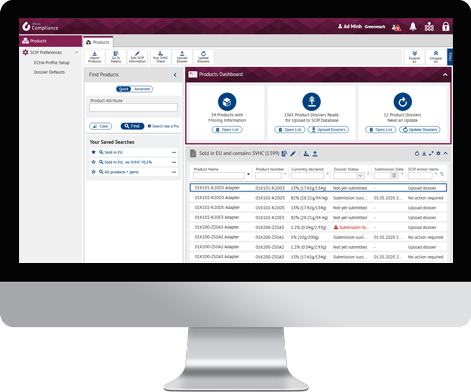
IPOINT's software solutions help companies simplify Prop 65 workflows and scale their compliance efforts. Our tools support structured data management, supplier communication, and regulatory documentation across complex product portfolios.
Collect and manage full material declarations, verify substance presence, and ensure compliance with Prop 65 and other global regulations. Whether you're updating warning labels or preparing for an enforcement check, IPOINT helps businesses meet California Proposition 65 requirements with confidence and future-proof their compliance strategy.

Frequently Asked Questions
What's the difference between Prop 65 and TSCA?
Prop 65 requires consumer warnings for listed chemicals that exceed exposure limits. TSCA regulates the manufacturing and use of chemicals in the U.S. – it doesn't require consumer labeling.
Do online-only retailers need to post warnings?
Yes. If a product sold online requires a Prop 65 warning, it must be shown clearly before purchase on the product page or during checkout.
Who in the supply chain is responsible for providing a Prop 65 warning?
The obligation can apply to any party placing the product on the California market – including manufacturers, importers, and retailers.
What penalties and settlement costs can companies face if they fail to provide a California Proposition 65 warning?
Non-compliance can lead to civil penalties of up to $2,500 per violation per day – plus legal fees and costly settlements in private lawsuits.