
Today, companies face the dual challenge of achieving profitability while minimizing their environmental impact. Eco efficiency analysis helps organizations navigate this challenge by making sustainability and financial performance work together.
- Eco Efficiency Analysis: Key Facts at a Glance
- What Is Eco Efficiency?
- Life-Cycle Assessment (LCA)–Based Calculation Systems
- The WBCSD's Seven Elements of Eco Efficiency
- Benefits for Companies Pursuing Eco Efficiency
- How IPOINT Supports Your Eco Efficiency
- Frequently Asked Questions
Eco Efficiency Analysis: Key Facts at a Glance
-
Eco-efficiency measures the ratio of economic value created to environmental impact generated – the higher the ratio, the more eco-efficient a product or process.
-
The concept was coined in 1992 by the Business Council for Sustainable Development (BCSD) and later standardized in ISO 14045, which was reviewed and confirmed as current in 2024.
-
Two leading LCA-based methodologies exist: BASF's Eco Efficiency Analysis and Delft University of Technology's eco-costs value ratio method.
-
Eco efficiency analysis supports strategic product decisions, drives innovation, and is increasingly relevant for CSRD and ESG reporting requirements.
-
Companies pursuing eco efficiency benefit from cost savings, stronger market positioning, and measurable contributions to a sustainable business environment.
What Is Eco Efficiency?
Eco-efficiency is a key metric that defines the relationship between economic output (value added) and the emissions and environmental impact generated. It encompasses both economic and monetary indicators as well as ecological ones. To assess environmental impacts, such as carbon footprint, the life cycle assessment method is often used. Alternatively, emissions, energy consumption, or waste volume can also serve as key figures.
At its core, eco-efficiency is expressed as a simple ratio:
Eco-efficiency = Economic value created / Environmental impact generated
The higher this ratio, the more value a company produces per unit of environmental burden. This makes eco-efficiency a practical decision-making tool: it allows organizations to compare product variants, processes, or investment options based on both their economic returns and their environmental footprint.
The term eco-efficiency was coined in 1992 by the Business Council for Sustainable Development (BCSD) – the predecessor to today's World Business Council for Sustainable Development (WBCSD) – in its landmark publication Changing Course. This approach is centered on the idea of producing more goods while using fewer resources and generating less waste and pollution.
The principles, requirements, and guidelines for assessing the eco-efficiency of product systems are detailed in ISO 14045. The standard was reviewed and confirmed as current in 2024. By following these standards, companies can effectively balance the demands of economic growth with the necessity of reducing their environmental impact.
For companies, increasing eco-efficiency is desirable to align sustainability goals with economic objectives. Additionally, measures to reduce environmental impacts can be evaluated and compared in terms of their cost-effectiveness.
Life-Cycle Assessment (LCA)–Based Calculation Systems
Two prominent life-cycle assessment (LCA) based calculation systems are utilized to evaluate eco-efficiency. The first is the analysis method developed by BASF, which provides a comprehensive framework for assessing the environmental impacts of products and processes throughout their life cycle. The second is the eco-costs value ratio method created by Delft University of Technology, which focuses on quantifying the environmental costs associated with products and comparing them to their economic value. Both systems offer valuable insights into how businesses can improve their eco-efficiency by minimizing environmental impacts while maximizing economic benefits.
BASF's Eco Efficiency Analysis
BASF – as one of the world's largest chemical companies – introduced the eco-efficiency analysis tool in the 1990s. They have long been aware of their responsibility toward the environment and society. For example, BASF committed itself to the ideas of Sustainable Development and Responsible Care at the beginning of the 1990s. BASF is also a member of the World Business Council for Sustainable Development and the United Nations Global Compact Initiative.
The method of eco-efficiency analysis allowed BASF to consider ecological and economic aspects together in the development. Furthermore, it enabled the optimization of products or processes and the most eco-efficient product or process variant to be identified in each case.
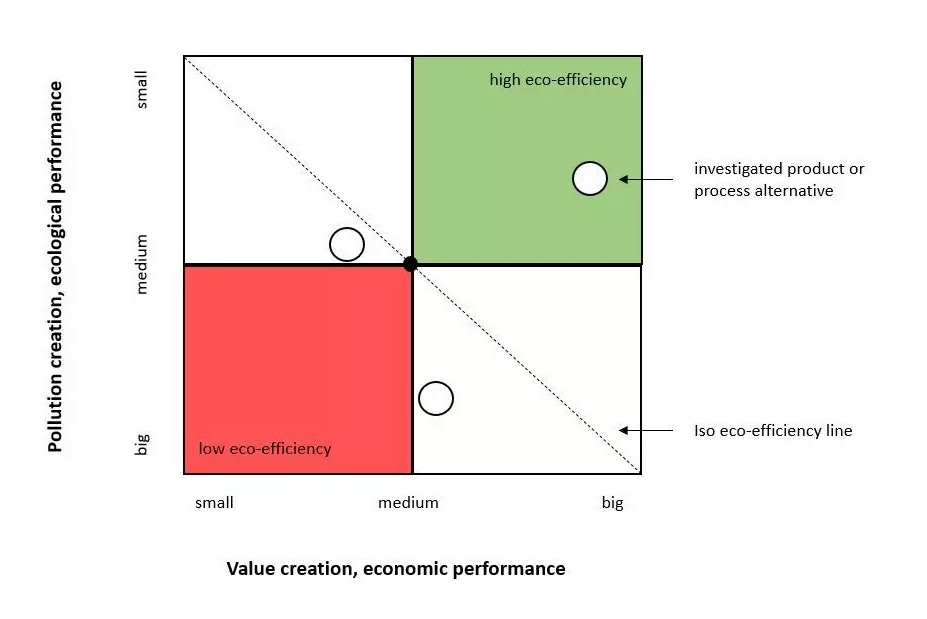
Eco-efficiency analysis is frequently applied at the product or process level to achieve more sustainable manufacturing. This involves using various indicators to measure economic performance, such as sales potential and profitability. To gauge environmental performance, a life cycle assessment according to ISO 14044 is conducted, which evaluates the environmental impacts of a product or process throughout its entire life cycle.
The results from both economic and environmental measurements are then compiled into a portfolio diagram. This visual representation helps in identifying the most eco-efficient solutions or products, enabling businesses to make informed decisions that balance economic gains with environmental responsibility.
Advantages
- Support for Strategic Decision-making: Eco-efficiency analysis helps distinguish sustainable products from less sustainable ones, aiding strategic decision-making for specific applications. It provides valuable information for investment considerations, guiding companies towards more sustainable choices.
- Support for Product Development: Conducting eco-efficiency analysis supports research and product development efforts. It allows early identification of promising products and quantifies the most influential factors for their success.
- Involving the Customers: Eco-efficiency analysis considers the entire life cycle of the product, integrating customer influences into the analysis. This facilitates communication of a holistic view of the product life cycle to the customer, fostering transparency.
Disadvantages
- Complexity: Identifying and quantifying every single environmental and social impact of products and processes is challenging. While eco-efficiency analysis offers an overview, it may not fully represent reality due to this complexity.
- Risk of Misinterpretation: The summarized nature of information in eco-efficiency analysis leaves room for misinterpretation, posing a risk of misunderstanding the true environmental and economic implications.
- Not Fully Aligned with Sustainability Goals: Critics argue that eco-efficiency doesn't necessarily equate to environmental friendliness. Some products deemed eco-efficient may still not be entirely environmentally friendly or waste-free. Critics advocate for a focus on eco-effectiveness, aiming for products that are truly sustainable and waste-free. Additionally, social aspects, a crucial pillar of sustainability, are often insufficiently considered in eco-efficiency analysis.
Difference between Eco Efficiency and Eco Effectiveness
Eco efficiency aims to maximize value creation while minimizing environmental impact through efficiency gains, focusing on doing "more with less" and reducing the environmental footprint per unit of economic output. In contrast, eco effectiveness goes further by redesigning products and processes to be inherently sustainable, aiming for zero waste and positive environmental impacts throughout their life cycle.
While eco efficiency focuses on optimization and efficiency, eco effectiveness prioritizes solutions that actively contribute to environmental and social sustainability, emphasizing holistic redesign rather than simply reducing impact.
In evaluating product development processes, effectiveness can be seen as "doing the right things," while efficiency is "doing things right." These measures also apply to environmental performance, where eco-effectiveness improves the total impact on the environment by satisfying consumer needs in ways that contribute more to ecosystem sustainability, while eco-efficiency improves environmental performance by reducing environmental burden across the product's life cycle.
The WBCSD's Seven Elements of Eco Efficiency
The World Business Council for Sustainable Development (WBCSD) has identified seven key elements that define eco-efficient business conduct. These elements serve as a practical framework for companies looking to translate the eco-efficiency concept into measurable action:
- Reduce the material intensity of goods and services
- Reduce the energy intensity of goods and services
- Reduce the dispersion of toxic substances
- Enhance the recyclability of materials
- Maximize the use of renewable resources
- Extend the durability and useful life of products
- Increase the service intensity of goods and services
Companies that systematically work through these seven elements typically uncover significant cost reduction potential alongside environmental improvements. 3M's well-known Pollution Prevention Pays program, for instance, achieved cumulative first-year savings of more than $800 million by eliminating pollution at the source – demonstrating that eco-efficiency is not just an environmental goal but a genuine business strategy.
Benefits for Companies Pursuing Eco Efficiency
Companies aiming for eco efficiency stand to gain various advantages in their operations and market positioning. By setting goals to reduce material and energy consumption, enhance recyclability, maximize renewable resources utilization, extend product life, and improve product and service benefits, these companies pave the way for sustainability-driven practices.
One significant benefit is cost savings achieved through efficient resource utilization. Pursuing eco efficiency also drives innovation, leading to new solutions and products in the field. Moreover, companies embracing eco efficiency become more attractive to environmentally conscious customers, enhancing their market position and competitiveness. Simultaneously, they also become more appealing as employers, attracting talent interested in sustainability and corporate responsibility.
The results from practice back this up. Fujitsu, together with the bifa environmental institute, conducted a Life Cycle Assessment of its computer hardware using IPOINT's LCA software Umberto. The study revealed that greenhouse gas emissions are the most relevant environmental performance indicator – and that the use phase alone accounts for 50% of the total carbon footprint. Insights like these enable targeted improvement measures that reduce both environmental impact and operational costs.
Furthermore, by adopting eco-efficient practices, companies contribute to creating a sustainable business environment. This not only enhances their reputation but also strengthens relationships within their industry and community.
Eco efficiency is also increasingly relevant from a regulatory perspective. Under the EU's Corporate Sustainability Reporting Directive (CSRD), companies are required to disclose detailed environmental performance data across their entire value chain – including Scope 3 emissions. Eco efficiency analysis provides exactly the kind of LCA-based data that supports these disclosures, making it both a strategic and a compliance-relevant tool for CSRD reporting.
How IPOINT Supports Your Eco Efficiency

Our Software for Life Cycle Assessment and Resource Efficiency
Master the challenge of achieving eco-efficiency with your products through our LCA software Umberto. Our expert-level LCA software enables comprehensive life cycle assessments and carbon footprints aligned with ISO 14040/14044. It combines powerful visualization, integrated LCI databases, and material flow cost accounting to help you optimize your products from both an ecological and economic perspective.
Our Comprehensive Sustainability Consulting Services
Come aboard and let us discover what opportunities and possibilities the analysis of your products regarding eco-efficiency has in store for you. Together with our sustainability consulting services you will enable sustainable manufacturing.
Frequently Asked Questions
What does eco-efficiency mean?
Eco-efficiency describes the relationship between the economic value a product or process creates and the environmental impact it generates. The higher the economic value relative to the environmental burden, the more eco-efficient a system is.
What is an example of eco-efficiency?
3M's Pollution Prevention Pays program is a classic example: by eliminating pollution at the source, the company achieved over $800 million in cumulative first-year savings while significantly reducing its environmental footprint. In manufacturing, producing the same output with 20% less energy also represents a clear eco-efficiency gain.
How do you calculate eco-efficiency?
Eco-efficiency is calculated as a ratio: economic value created divided by environmental impact generated. The economic value can be expressed as revenue, value added, or profit; the environmental impact is typically quantified through a life cycle assessment (LCA) covering CO₂ emissions, energy consumption, or waste volume.
What are the 3 E's of sustainability?
The 3 E's of sustainability stand for Environment, Economy, and Equity (the social dimension). Eco-efficiency directly addresses the first two pillars by linking economic output to environmental performance, while critics note that the social dimension is often underrepresented in eco-efficiency analyses.
How does eco-efficiency differ from eco-effectiveness?
Eco-efficiency focuses on doing more with less – reducing environmental impact per unit of economic output. Eco-effectiveness goes further by redesigning products and processes from the ground up to be inherently sustainable, aiming for zero waste and net-positive environmental outcomes rather than merely optimizing existing systems.
How can software support eco-efficiency analysis?
LCA software like Umberto automates the data collection, impact assessment, and reporting required for a rigorous eco-efficiency analysis. It integrates recognized LCI databases, enables scenario comparisons, and generates audit-ready results aligned with ISO 14040/14044 – significantly reducing the time and effort involved in assessing product eco-efficiency.