

The European Sustainability Reporting Standards (ESRS) are the technical backbone of EU sustainability reporting. Issued under the Corporate Sustainability Reporting Directive (CSRD), they define what companies must disclose – across environmental, social, and governance topics – and how those disclosures must be structured.
For companies subject to the CSRD, the ESRS are not optional. This guide covers the full structure of the 12 standards, how double materiality works, what the ESRS simplification changes, and why data availability matters as much as the reporting requirement itself.
- ESRS: Key Facts at a Glance
- How Do the ESRS and CSRD Work Together?
- What Do the 12 ESRS Standards Cover?
- What Is Changing with ESRS 2.0?
- What Is Double Materiality and Why Does It Matter?
- How Do Companies Source ESRS Reporting Data?
- From ESRS Standards to Strategy
- FAQ
ESRS: Key Facts at a Glance
-
Mandatory standards: The ESRS operationalize the CSRD, turning a legal disclosure obligation into concrete datapoints and reporting requirements.
-
Twelve standards in total: Two cross-cutting standards (ESRS 1 and ESRS 2) plus ten topic-specific standards covering environment, social, and governance.
-
Double materiality: Assessing both the company's impact on people and the environment and sustainability risks to the business remains mandatory under all versions of the ESRS.
-
Simplification underway: The ongoing revision cuts mandatory datapoints by more than 60%; the 12-standard structure stays in place.
-
Limited assurance: ESRS disclosures are subject to limited assurance, adding a formal verification layer to sustainability reporting.
How Do the ESRS and CSRD Work Together?
The CSRD is the law: it defines which companies must report and on what timeline. The ESRS are the standards: they specify what must be reported and how. Together, they form a single compliance system. One sets the obligation, the other makes it operational.
Every disclosure requirement, datapoint, and reporting structure a CSRD-obligated company needs to follow traces directly back to the ESRS. Understanding the standards is, in that sense, the technical prerequisite for CSRD compliance.
What Do the 12 ESRS Standards Cover?
The ESRS consist of 12 standards organized in two layers. Cross-cutting standards apply to every company, regardless of sector:
-
ESRS 1 (General Requirements): defines reporting concepts, principles, and the methodology for applying double materiality
-
ESRS 2 (General Disclosures): requires baseline disclosures on governance, strategy, impact, risk and opportunity management, and metrics and targets – mandatory for all CSRD-reporting companies
Topic-specific standards apply based on the outcome of the company's materiality assessment:
| Area | Standards | Topics |
|---|---|---|
| Environment (E) | E1–E5 | Climate Change, Pollution, Water & Marine Resources, Biodiversity, Resource Use & Circular Economy |
| Social (S) | S1–S4 | Own Workforce, Workers in the Value Chain, Affected Communities, Consumers & End-Users |
| Governance (G) | G1 | Business Conduct |
What Is Changing with ESRS 2.0?
Under the CSRD Omnibus Directive, the European Financial Reporting Advisory Group (EFRAG) and the European Commission reworked the ESRS. The Commission published the draft delegated act on May 6, 2026; the public consultation closed June 3, 2026. Formal adoption is expected in mid-to-late 2026, followed by a parliamentary review of up to four months.
-
What changes: Mandatory datapoints are cut by more than 60%, all voluntary datapoints are removed, and the approach becomes more principles-based.
-
What stays: The 12-standard structure, double materiality, and the core reporting obligation remain intact.
The simplified standards apply from FY 2027. Voluntary early application for FY 2026 is possible, though the practical window depends on the final adoption timeline.
What Is Double Materiality and Why Does It Matter?
Double materiality is the central analytical framework of the ESRS. It requires companies to assess sustainability issues from two angles simultaneously:
-
Impact materiality: the company's effects on people and the environment
-
Financial materiality: how sustainability topics affect the company's own financial position and cash flows
Despite widespread expectations that simplification would ease this requirement, double materiality remains fully mandatory. The materiality assessment determines which topic-specific standards apply, making it the logical starting point of every ESRS implementation. And it surfaces the critical question that follows: where does the data actually come from?
How Do Companies Source ESRS Reporting Data?
Most companies start with the question: "How do we comply with the ESRS?" The more productive question is: "How do we use this data to make better decisions?"
Scope 3 emissions across the value chain represent the most data-intensive requirement under ESRS E1 and the area where most companies face the steepest operational challenge. This is where ESRS reporting becomes an infrastructure problem rather than a straightforward disclosure exercise. For a deeper look at how Scope 3 fits into CSRD obligations, see our article on CSRD and Scope 3 emissions.
The same value chain data also feeds a related but distinct obligation: the Corporate Sustainability Due Diligence Directive (CSDDD) requires the largest in-scope companies to actively identify and address human rights and environmental risks across their chain of activities, rather than simply disclosing them. Companies building an ESRS data foundation are, in effect, building the same infrastructure the CSDDD demands.
IPOINT's approach covers the full data lifecycle required for ESRS-aligned sustainability steering:
-
Collect: gather product, process, energy, and supplier data
-
Analyze: calculate PCF, run LCAs, identify hotspots, and model scenarios
-
Govern: manage roles, data quality, and calculation cycles
-
Report: generate audit-ready outputs for ESRS/CSRD, EPD, and DPP
-
Evolve: drive improvements across materials, suppliers, and processes
-
Scale: move from pilot projects to portfolio-level sustainability steering
Manage Your Corporate Carbon Footprint Across the Value Chain
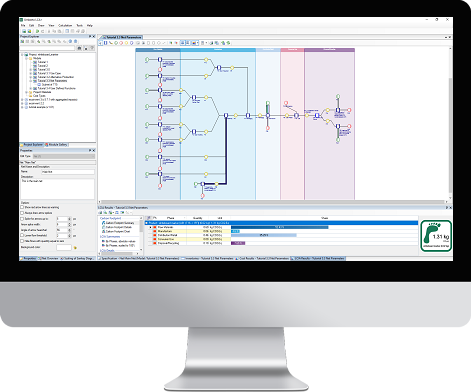
Calculate product and corporate carbon footprints with audit-ready results for ESRS E1 and CSRD reporting. Connect Scope 1, 2, and 3 data in a single compliance-ready workflow.

From ESRS Standards to Strategy
The ESRS define what to report. The simplification reduces the workload but not the underlying obligation. The 12-standard structure and double materiality remain in place.
The more valuable shift is treating the ESRS not as a compliance exercise but as a steering framework. Companies that build robust data infrastructure now – not just to report, but to analyze and improve – will be better positioned than those focused solely on minimum disclosure.
Turn ESRS Data Into Smarter Sustainability Decisions

See how leading companies move from ESRS compliance to data-driven sustainability steering, using a structured six-step framework.

Frequently Asked Questions
What is the difference between ESG and ESRS?
ESG (Environmental, Social, and Governance) is a broad framework used in investment analysis, ratings, and voluntary reporting. The ESRS are mandatory EU standards that operationalize the CSRD. ESG describes what companies aim to measure; the ESRS define what CSRD-obligated companies must disclose, in a specific structure with defined datapoints, subject to limited assurance.
What are the four reporting areas of the ESRS?
The ESRS organize reporting into four areas: the cross-cutting framework (ESRS 1 and ESRS 2, mandatory for all companies), Environment (E1–E5), Social (S1–S4), and Governance (G1). The cross-cutting standards apply universally; the three topic-specific areas apply based on the outcome of the materiality assessment.
Is ESRS 2 mandatory?
Yes. ESRS 2 (General Disclosures) is mandatory for all CSRD-reporting companies, regardless of sector or materiality outcome. It requires baseline disclosures on governance, strategy, impact, risk and opportunity management, and metrics and targets, forming the foundation every ESRS report must include.
What is the difference between IFRS and ESRS?
The International Financial Reporting Standards (IFRS) govern financial reporting. The ESRS govern sustainability reporting under EU law. The ISSB's IFRS S1 and S2 address sustainability-related financial disclosures but are currently voluntary in the EU. The ESRS are mandatory for CSRD-obligated companies and cover a significantly broader range of topics.
Are the ESRS changing in 2026?
Yes. Under the CSRD Omnibus Directive, the European Commission published a draft revised delegated act in May 2026. The simplified standards – commonly referred to as "ESRS 2.0" – are expected to be formally adopted in mid-to-late 2026 and apply from FY 2027. Voluntary early application for FY 2026 is possible, though the practical window depends on the final adoption timeline.