Circular economy electronics has moved from a sustainability talking point to a regulatory and commercial necessity. Electronics manufacturers now face binding rules on batteries, e-waste, and repairability, not just voluntary sustainability goals.
This guide covers what circularity actually means for electronics, why batteries carry the sharpest regulatory pressure in this space, and what the EU Circular Economy Act, WEEE reform, and Right to Repair mean for manufacturers over the next two years.
- Circular Economy Electronics: Key Facts at a Glance
- What Circularity Means for Electronics
- Battery Second-Life: What Happens When Capacity Drops
- Battery Recycling and Urban Mining
- Digital Product Passport and Battery Passport for Electronics
- E-Waste: How Big Is the Problem?
- The EU Circular Economy Act and WEEE Reform
- Right to Repair and Design for Circularity
- Circular Business Models for Electronics Manufacturers
- Critical Raw Materials and Semiconductor Circularity
- Keeping Circular Electronics Data-Ready with IPOINT
- FAQ
Circular Economy Electronics: Key Facts at a Glance
-
Batteries carry the most pressure: Batteries carry the highest search demand and the sharpest regulatory pressure in this space: second-life use, recycling quotas, and urban mining.
-
Right to Repair is live: As of July 2026, EU manufacturers must keep spare parts and repair information accessible under the new Right to Repair Directive.
-
Battery Passport in February 2027: The Battery Passport becomes mandatory on February 18, 2027, for electric vehicle, light transport, and industrial batteries above 2 kWh.
-
EU Circular Economy Act coming: A new EU Circular Economy Act is expected in late 2026, aiming to build a single market for secondary raw materials and sharply raise material circularity across the bloc.
What Circularity Means for Electronics
For electronics, closing the loop is harder than in most sectors. Product cycles are short, components are miniaturized, and many materials are simultaneously regulated hazards and valuable secondary resources within the same device.
Circularity covers the full product lifecycle:
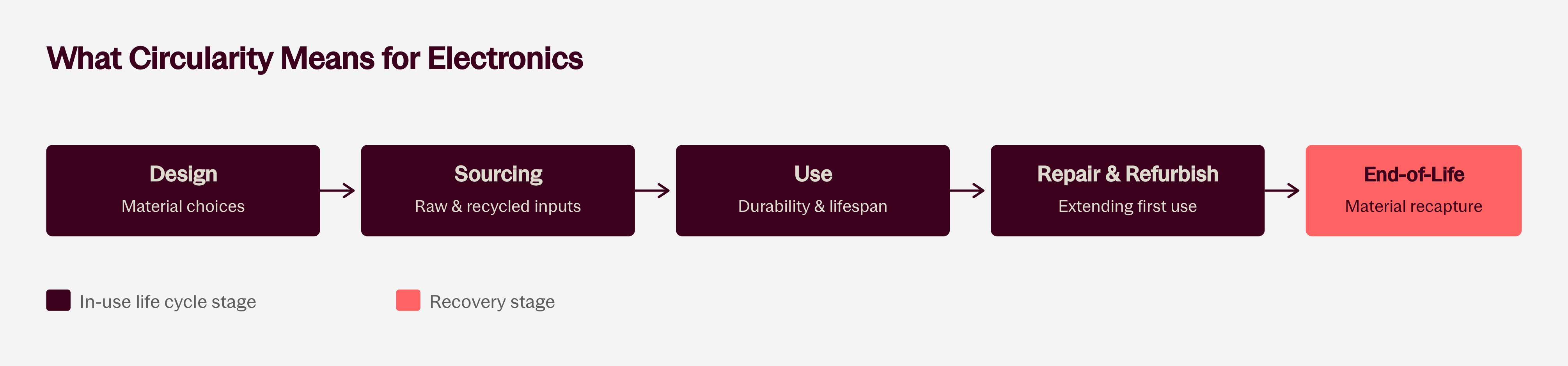
The five stages of circularity in electronics, from design through end-of-life recovery.
That tension between compliance and material recovery is the throughline running through our articles on Circular Economy and Sustainability and the broader sustainability challenges facing the electronics industry.
Battery Second-Life: What Happens When Capacity Drops
Industrial and consumer batteries don’t stop being useful once they fall below the capacity threshold for their original application. In practice, that threshold typically sits around 70-80% of original capacity, still well suited for less demanding uses.
Second-life applications, such as stationary energy storage and renewable energy buffering, extend a battery’s working life well beyond its first use case. Whether a battery goes to second-life use or straight to recycling depends on remaining capacity, cell chemistry, and safety and warranty considerations.
This applies across consumer and industrial electronics generally, not just electric vehicles, where second-life battery strategy is its own, more specialized topic.
See Circular Economy Solutions in Practice
Manage material and lifecycle data across the battery value chain, from sourcing to second-life and recycling.

Battery Recycling and Urban Mining
The EU Battery Regulation sets binding material recovery targets for waste batteries. According to the European Commission, these targets are:
| Material | By End of 2027 | By End of 2031 |
|---|---|---|
| Lithium | 50% | 80% |
| Cobalt, copper, nickel & lead | 90% | 95% |
EU Battery Regulation material recovery targets for waste batteries.
These targets turn used batteries into a domestic raw material source, often called urban mining, reducing dependence on primary extraction. For the environmental case behind that shift, see the LCA of Lithium-Ion Batteries.
Digital Product Passport and Battery Passport for Electronics
The Battery Passport becomes mandatory on February 18, 2027, for electric vehicle (EV), light means of transport (LMT), and industrial batteries above 2 kWh under the EU Battery Regulation (EU 2023/1542). It will carry data on composition, carbon footprint, and state of health, accessible via a QR code.
It’s the first live application of the broader Digital Product Passport (DPP) framework, which is set to extend to electronics and textiles from 2027 onward.
E-Waste: How Big Is the Problem?
The world generated 62 million tons of e-waste in 2022, but the Global E-Waste Monitor 2024 found that formal recycling systems captured just 22.3% of it. That total is projected to climb to 82 million tons by 2030, growing faster than documented recycling can keep pace.
In the EU specifically, nearly half of all e-waste generated still goes uncollected, per the European Commission’s 2025 WEEE evaluation. That collection gap is exactly what sets up the next wave of EU regulation. Our article E-Waste Dilemma: The Environmental Impact of Electronics covers this in more depth.
The EU Circular Economy Act and WEEE Reform
The European Commission is expected to formally propose the EU Circular Economy Act in the second half of 2026, building on the Circular Economy Action Plan as part of the Clean Industrial Deal. The goal is a functioning single market for secondary raw materials. It would also roughly double the EU’s material circularity rate, currently at 12.2%, toward a 2030 target of 23.2%, according to Eurostat.
The Commission’s July 2025 WEEE Directive evaluation is expected to feed directly into this Act. It identified several gaps a revision would need to close:
-
outdated scope that misses newer waste streams, such as digital and renewable-energy equipment
-
inconsistent critical raw material recovery across Member States
-
fragmented Extended Producer Responsibility implementation
Right to Repair and Design for Circularity
The EU Right to Repair Directive (2024/1799) became applicable across the EU on July 31, 2026, according to the European Commission. For products covered by the directive, such as washing machines, mobile phones, tablets, and servers, it requires:
-
a 12-month extension of the legal guarantee when a consumer chooses repair over replacement
-
accessible repair information and spare parts at a reasonable price
-
no contractual, hardware, or software barriers that block independent repair
The Ecodesign for Sustainable Products Regulation (ESPR) underpins the repairability requirements behind this, pushing modular, repairable product design from a nice-to-have into a baseline expectation, visible in products from Fairphone, Framework, and Jabra.
Circular Business Models for Electronics Manufacturers
Ownership models are shifting alongside the regulation. Product-as-a-service and device leasing reduce the incentive to design for obsolescence, since the manufacturer retains responsibility for the asset’s full lifecycle.
Take-back programs, such as those run by Apple and Dell, and remanufacturing models adapted from other industries are becoming more common, though still less mature in electronics than in automotive. Our Circular Business Models article covers these approaches in more depth, with practical examples.
Critical Raw Materials and Semiconductor Circularity
Electronics manufacturing depends heavily on rare earths, lithium, and cobalt, sourced through supply chains that fall under responsible minerals sourcing obligations. The EU Critical Raw Materials Act, in force since May 2024, sets 2030 benchmarks of 10% domestic extraction, 40% domestic processing, and 25% recycling for strategic raw materials, while capping dependence on any single non-EU country at 65%, according to the European Commission.
On the research side, EU-funded initiatives like SUSTRONICS, backed by the Chips Joint Undertaking, are exploring eco-design, bio-based materials, and circular value chains for electronics components, a comparatively fresh angle beyond standard e-waste recycling.
Keeping Circular Electronics Data-Ready with IPOINT
Circularity in electronics runs through three things, and all three depend on the same underlying requirement: reliable material and lifecycle data across the supply chain.
-
Battery data: composition, recycled content, and second-life eligibility
-
E-waste and WEEE compliance: collection, recovery, and reporting obligations
-
Design decisions: material choices that determine repairability and recyclability
IPOINT’s Compliance Intelligence and Sustainability Intelligence solutions manage this data and prepare it for Digital Product Passport requirements, an approach also relevant across automotive and electronics circular economy transitions.
Manage Circular Economy Data in One Place
Track material composition, battery lifecycle, and Digital Product Passport readiness across your supply chain.
Want the broader data framework behind this? Our Sustainability Intelligence Whitepaper walks through how manufacturers turn sustainability data into measurable impact.
Frequently Asked Questions
How does e-waste fit into a circular economy model?
E-waste represents lost material value. A circular model recovers metals and components from end-of-life electronics instead of sending them to landfill, feeding recovered materials back into new production.
Is battery recycling mandatory in the EU?
Yes. Producers must meet binding EU material recovery targets for lithium, cobalt, copper, nickel, and lead recovered from waste batteries, with the requirements tightening again in 2031.
What is urban mining?
Urban mining is the recovery of metals like lithium, cobalt, and nickel from products that have already been manufactured and used, such as batteries and electronics, rather than extracting them from the ground.
What is the difference between eco-design and circular design?
Eco-design focuses on reducing a product’s environmental footprint, including energy use and materials. Circular design goes further, explicitly designing for disassembly, repair, and material recovery at end-of-life.
When does the Digital Product Passport become mandatory for electronics?
There’s no single mandatory date for electronics generally. The Battery Passport is the first enforced deadline, and further Digital Product Passport requirements are expected to roll out sector by sector under the Ecodesign for Sustainable Products Regulation.