RoHS – the Restriction of Hazardous Substances Directive (2011/65/EU) – restricts the use of ten hazardous substances in electrical and electronic equipment (EEE) sold in the EU. Directive (EU) 2025/2456 entered into force on January 1, 2026, and transfers the directive's scientific and technical assessments to the European Chemicals Agency (ECHA), effective August 13, 2027.
For anyone bringing EEE onto the EU market, RoHS compliance is not optional. This guide covers what RoHS actually restricts, how RoHS 3 changed the rules, what counts as RoHS compliant, and why supply-chain data, not the regulation itself, is where compliance gets hard.
- RoHS Compliance: Key Facts at a Glance
- What Is RoHS?
- What Are the 10 RoHS Restricted Substances?
- RoHS vs. RoHS 3: What Actually Changed?
- Who Must Comply, and What Does RoHS Compliant Mean?
- RoHS Certification and Declaration: How Do You Prove Compliance?
- Where RoHS Compliance Actually Gets Hard: Supply-Chain Data
- China RoHS and Other Regional Variants
- Keeping RoHS Compliance Audit-Ready with IPOINT
- FAQ
RoHS Compliance: Key Facts at a Glance
-
Scope and thresholds: RoHS restricts 10 substances in electrical and electronic equipment sold in the EU, at thresholds of 0.1% or 0.01% by weight.
-
ECHA takes over in 2027: From August 13, 2027, ECHA will handle RoHS exemption and substance review procedures, a task currently managed by the Commission.
-
No central certificate: There is no central RoHS certificate. Compliance rests on self-declaration, technical documentation, and testing.
-
Regional variants exist: Regional variants such as China RoHS, Korea’s equivalent, India’s rules, and Japan’s J-MOSS follow similar logic but differ in scope.
What Is RoHS?
RoHS is formally Directive 2011/65/EU, often called “RoHS 2.” It restricts hazardous substances in EEE to protect health and the environment across manufacturing, use, and end-of-life.
The directive’s scope covers eleven EEE categories, from large household appliances to medical devices, and it extends to components such as cables within that equipment. Equipment with built-in batteries can fall under both RoHS and the EU Battery Regulation, and end-of-life treatment connects directly to the broader e-waste and WEEE framework.
What Are the 10 RoHS Restricted Substances?
RoHS in electronics comes down to ten substances split into two groups: four heavy metals and two flame retardants from the original directive, plus four phthalates added under RoHS 3. Each substance has a maximum concentration value per homogeneous material, according to the European Commission.
| Substance | Group | Threshold |
|---|---|---|
| Lead | Heavy metal | 0.1% |
| Mercury | Heavy metal | 0.1% |
| Cadmium | Heavy metal | 0.01% |
| Hexavalent chromium | Heavy metal | 0.1% |
| PBB | Flame retardant | 0.1% |
| PBDE | Flame retardant | 0.1% |
| DEHP | Phthalate | 0.1% |
| BBP | Phthalate | 0.1% |
| DBP | Phthalate | 0.1% |
| DIBP | Phthalate | 0.1% |
The 10 RoHS-restricted substances by group and maximum concentration threshold per homogeneous material.
These limits apply per homogeneous material, not per finished product. A single component can contain several homogeneous materials, and each one must independently stay under threshold, a challenge that multiplies across a full bill of materials (BOM).
See Your Restricted Substances Across the Full BOM
Track all 10 RoHS substances and their thresholds across every material and supplier automatically.

RoHS vs. RoHS 3: What Actually Changed?
A common misconception is that RoHS 3 is a separate law. It isn’t. RoHS 3 refers to Directive (EU) 2015/863, which amended the existing rules to add the four phthalates above, bringing the substance list from six to ten.
For products already compliant with the original six substances, RoHS 3 meant reassessing formulations against the new phthalate limits. And the shift of exemption and substance reviews to ECHA, effective August 2027, sets the process for any future update, sometimes referred to informally as a possible “RoHS 4.” For how RoHS relates to chemical registration more broadly, see our article on the EU REACH Regulation.
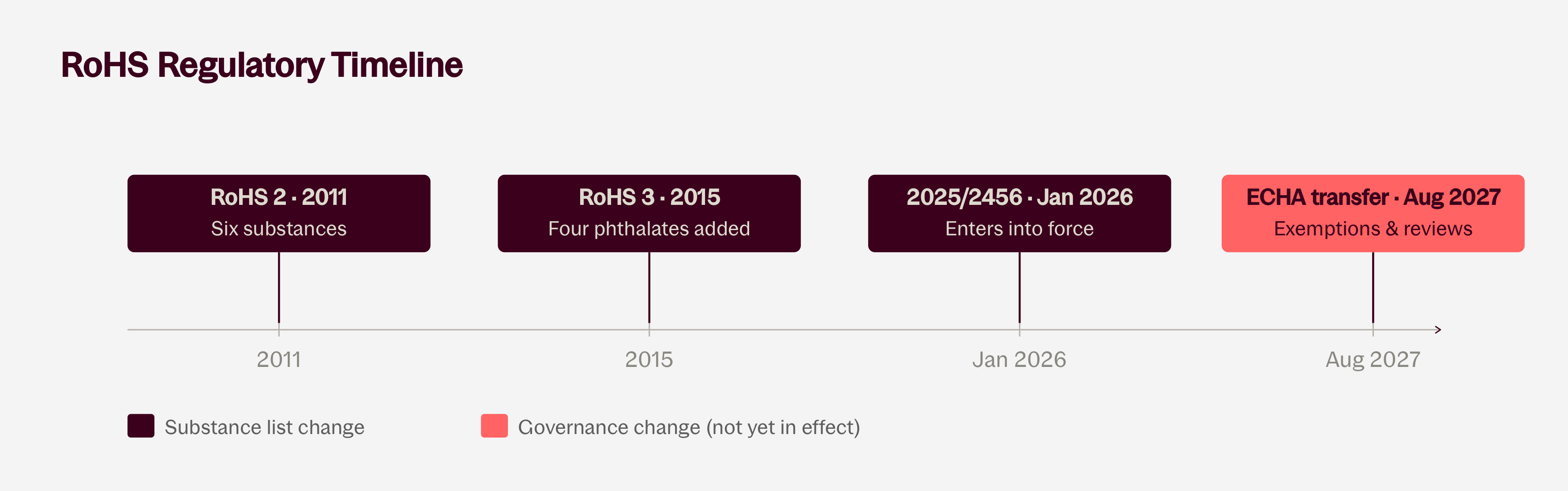
RoHS's regulatory timeline: from the original six-substance directive to the 2027 shift of exemption and substance-review procedures to ECHA.
Who Must Comply, and What Does RoHS Compliant Mean?
RoHS compliance obligations apply to manufacturers, importers, and distributors placing EEE on the EU market, including sellers based outside the EU. In practice, “RoHS compliant” means every homogeneous material stays under its threshold, or a valid exemption applies.
Exemptions exist for cases where substitution isn’t yet technically feasible, such as lead in certain high-melting-point solders. One notable carve-out: components built into vehicles generally fall under the ELV Directive rather than RoHS, a distinction covered in more depth in our article on automotive regulatory compliance.
RoHS Certification and Declaration: How Do You Prove Compliance?
RoHS has no central certificate and no single certifying body. Compliance rests on self-declaration, technical documentation, and substance testing, typically following IEC 62321 test methods for the ten restricted substances.
The Declaration of Conformity (often referred to as a RoHS declaration) is the document that carries this weight toward customers and market surveillance authorities. It’s worth separating two related but distinct requirements: RoHS and CE certification. RoHS is one of several legal requirements behind CE marking, not a synonym for it.
Where RoHS Compliance Actually Gets Hard: Supply-Chain Data
The restricted-substance list itself rarely changes. What’s genuinely difficult is collecting accurate, current substance data across a multi-tier supply chain, especially as parts, suppliers, and formulations shift over time.
The more useful question isn’t “are we compliant today?” It’s “can we prove and maintain that as our bill of materials evolves?” This connects directly to the ECHA SCIP database, an adjacent EU reporting obligation that runs on the same underlying material data.
China RoHS and Other Regional Variants
RoHS in electronics isn’t only an EU concept. China RoHS 2 relies on labeling and disclosure rather than the EU’s threshold-and-exemption model, requiring manufacturers to declare restricted substances rather than certify compliance upfront.
Other markets follow comparable but distinct approaches:
-
South Korea: restricts the same core substances at similar thresholds through its own resource-recycling legislation.
-
India: applies EU-aligned substance limits with a broader set of scope exemptions.
-
Japan: uses the J-MOSS marking system (JIS C 0950), which covers the original six substances for a narrower set of product categories than EU RoHS.
The takeaway for global manufacturers: RoHS compliant in the EU doesn’t automatically mean compliant elsewhere. Tracking more than one regulation, with country-specific documentation, is part of doing business across these markets.
Keeping RoHS Compliance Audit-Ready with IPOINT
RoHS’s core substance rules stay stable. The real, recurring work is proving compliance across parts and suppliers as your product portfolio changes, and doing that continuously rather than once.
IPOINT’s Compliance Intelligence platform supports this with Full Material Declarations, IMDS integration, and automated substance tracking across the BOM, keeping your data audit-ready. In practice, that means fewer manual supplier requests, one source of truth for material compliance data, and faster product launches.
Manage RoHS Substance Data Without the Manual Work
Automate Full Material Declarations and substance tracking across your entire bill of materials.
Want the data model behind this in more depth? Our Compliance Intelligence Whitepaper walks through how leading manufacturers structure audit-ready material compliance data at scale.
Frequently Asked Questions
Is RoHS required in the USA?
No. RoHS is an EU directive and doesn’t apply directly in the US. Some US states, such as California, have their own restricted-substance rules with narrower scope than EU RoHS.
What is the US equivalent of RoHS?
There is no single federal RoHS equivalent. The closest parallels are state-level laws, most notably California’s SB20/SB50, which regulate certain hazardous substances in specific electronic product categories.
How much does RoHS certification cost?
Since RoHS has no formal certification, there’s no fixed certification fee. Costs come from substance testing (often per homogeneous material via IEC 62321) and from building the technical documentation and Declaration of Conformity.
How do I get a product RoHS certified?
There’s no certificate to obtain. Compliance requires testing or verifying that all ten restricted substances stay under threshold, or that valid exemptions apply, then issuing a Declaration of Conformity.
Is China RoHS mandatory?
Labeling and disclosure requirements under China RoHS 2 are mandatory for products in scope. Formal compliance testing and marking, however, remain largely voluntary compared to the EU’s threshold-based model.