Life cycle thinking has become indispensable for companies navigating the EU's expanding sustainability regulations. Understanding the 5 product life cycle stages – from raw material extraction to end-of-life management – forms the foundation of every credible Life Cycle Assessment.
Yet confusion persists around which stages to include, how system boundaries shape environmental insights, and why cradle-to-gate assessments differ fundamentally from cradle-to-grave approaches.
This comprehensive guide explains the 5 product life cycle stages that structure every environmental assessment, explores how system boundaries determine assessment scope, and demonstrates how professional LCA software transforms raw data into strategic sustainability insights.
Table of Contents
- Product Life Cycle Stages: Key Facts at a Glance
- Why Life Cycle Stages Matter in LCA
- The 5 Product Life Cycle Stages
- Understanding LCA System Boundaries
- Conducting Professional LCAs with IPOINT's Umberto
- Integration with Sustainability Strategies
Why Life Cycle Stages Matter in LCA
Life cycle thinking shifts focus from isolated process optimization to holistic environmental management. Products generate environmental impacts across their entire physical existence – from initial resource extraction through final disposal or recovery.
This comprehensive perspective prevents burden-shifting, reducing impacts in one stage while inadvertently increasing them elsewhere. A lightweight component might reduce use-phase fuel consumption while demanding energy-intensive manufacturing. Without complete visibility, such trade-offs remain hidden.
Identifying true environmental hotspots requires stage-by-stage analysis. Consumer electronics often generate high impacts during use phase through electricity consumption, while industrial components concentrate impacts in raw material processing. Manufacturing-focused assessments miss these patterns entirely.
| Important clarification: This article focuses on the 5 product life cycle stages (raw materials, production, distribution, use, end-of-life), officially termed “stages” because they build upon each other sequentially. These differ from the 4 methodological phases of conducting an LCA per ISO 14040/14044 (Goal & Scope, Life Cycle Inventory, Impact Assessment, Interpretation), which are officially called “phases”. The term “stages” is commonly used for both concepts, which can cause confusion. |
The 5 Product Life Cycle Stages
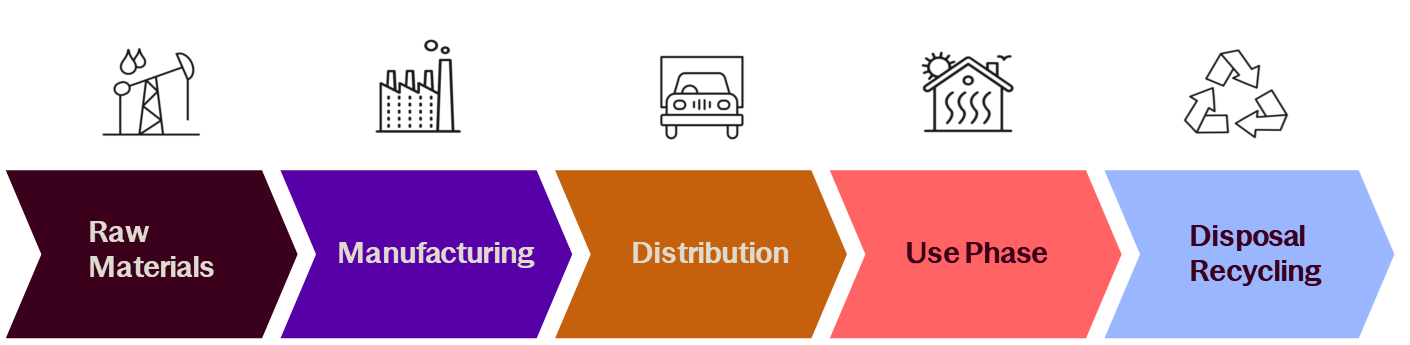
In a Life Cycle Assessment (LCA), environmental impacts are analyzed across five life cycle stages that together describe the product life cycle of a product system.
Stage 1: Raw Material Acquisition
The extraction, sourcing, and processing of raw materials generate environmental impacts related to resource depletion, energy use, emissions, land use, and water consumption. These upstream impacts are captured through life cycle inventory (LCI) data and are strongly influenced by material selection decisions made during product design.
Stage 2: Manufacturing / Production
Manufacturing transforms materials into finished products through energy- and resource-intensive processes. This stage includes process emissions, waste generation, and auxiliary material use. Improvements in manufacturing efficiency can reduce environmental impacts and often lead to measurable environmental and, in many cases, economic benefits.
Stage 3: Distribution / Transport
Distribution covers the transportation of materials, components, and finished products across the supply chain, contributing to transportation emissions and packaging impacts. In LCA, transport processes occur throughout the entire product life cycle and are modeled as part of individual stages, rather than as a single isolated step.
Stage 4: Use Phase
The use phase captures environmental impacts arising from product operation, maintenance, and energy or fuel consumption over the functional lifetime. For many energy-using products—such as appliances, vehicles, and electronics—the use phase can represent the dominant share of total life cycle impacts, sometimes accounting for the majority of the overall footprint.
Stage 5: End-of-Life
End-of-life modeling addresses waste treatment, recycling, and material recovery. This stage generates impacts through disposal processes while potentially creating environmental credits by substituting virgin material production. End-of-life assumptions, allocation methods, and recycling scenarios strongly influence final LCA results and are essential for circular economy assessments.
Understanding LCA System Boundaries
System boundaries define which processes, material and energy flows, and life cycle stages are included in a Life Cycle Assessment. They fundamentally shape the analytical scope of a study and directly influence the resulting environmental impacts and insights. Selecting appropriate system boundaries depends on the assessment goal, data availability, and the organization’s position within the value chain.
System boundaries are established during the Goal and Scope phase in accordance with ISO 14040/14044. They are closely linked to the functional unit, which describes the function provided by a product system, and the reference flow, which specifies the quantity of product required to fulfill that function. For example, a B2C assessment might define the functional unit as “one washing machine providing 10,000 wash cycles” and apply a cradle-to-grave boundary, while a B2B assessment may focus on “1 kg of component material” using a cradle-to-gate approach.
Cradle-to-Grave
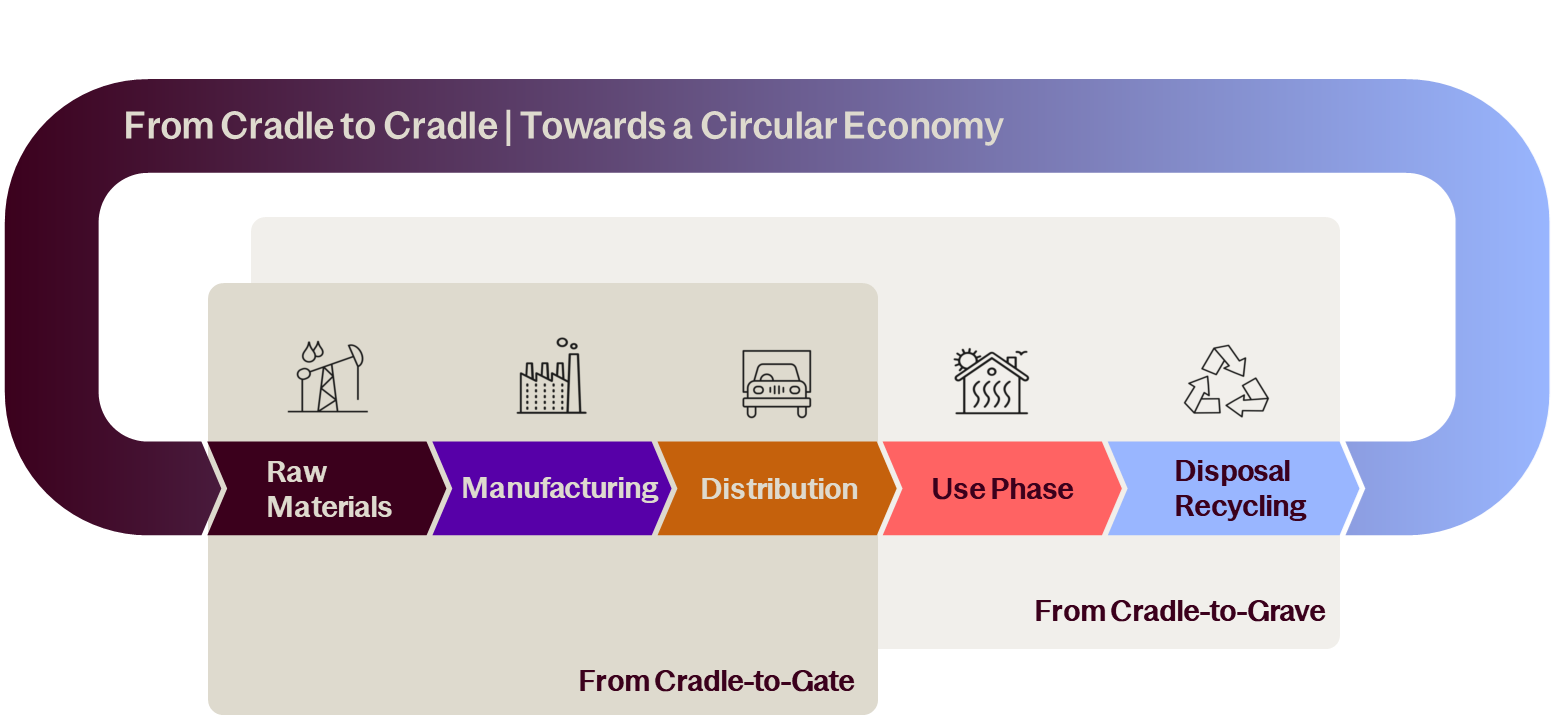
Cradle-to-Grave includes the complete life cycle from raw material extraction through all stages to disposal. It provides the most comprehensive environmental picture for product comparisons, Environmental Product Declarations (EPD), and carbon footprint labeling. B2C companies producing end-user products typically use this boundary.
Cradle-to-Gate
Cradle-to-Gate assessments end at the factory gate after manufacturing, excluding distribution, use, and end-of-life stages. This serves B2B supplier communication and prevents double-counting when customers integrate supplier data.
Why many B2B companies choose cradle-to-gate:
- Use phase is uncertain: B2B products undergo further processing in various applications.
- Customer requirements: OEMs and brand owners need precise supplier data to build comprehensive cradle-to-grave assessments rather than relying on generic database averages.
Cradle-to-Cradle
Cradle-to-cradle is primarily a circular economy and sustainable product design concept rather than a universally standardized LCA system boundary. In Life Cycle Assessment practice, cradle-to-cradle principles are typically represented through recycling scenarios, allocation methods, and avoided burden approaches, where recovered materials substitute virgin material production in subsequent product systems. These modeling choices strongly influence results and must be transparently documented.
Well-to-Wheel
Well-to-wheel (WTW) boundaries are specialized for transport fuels and vehicle energy systems. They are commonly divided into Well-to-Tank (fuel or energy production and distribution) and Tank-to-Wheel (vehicle operation). This approach excludes vehicle manufacturing and is widely used to compare fuel pathways and propulsion technologies under consistent assumptions.
Other System Boundary Models
Additional boundary definitions serve specific analytical purposes:
- Gate-to-gate: focuses on a single process or production step.
- Gate-to-grave: includes downstream stages but excludes raw material extraction.
- Cradle-to-use: omits end-of-life treatment.
These boundaries are often applied within broader assessment programs or screening studies.
Selecting the Right System Boundary
Choosing the appropriate system boundary requires strategic evaluation. The right boundary depends on multiple interconnected factors that shape both assessment feasibility and result relevance.
Key decision factors include:
- Role in the value chain (supplier vs. brand owner vs. end-product manufacturer)
- Assessment objectives (compliance, optimization, communication)
- Available data and resources
- Target audience expectations (B2B vs. B2C, internal vs. external stakeholders)
Common use cases:
- Component supplier → Cradle-to-gate for customer integration
- Consumer brand → Cradle-to-grave for comprehensive footprints
- Automotive OEM → Well-to-wheel for fuel/vehicle comparison
- Circular economy initiative → Cradle-to-cradle for material recovery
Avoiding pitfalls: Inappropriate boundaries hide burden-shifting risks. Manufacturing improvements increasing use-phase impacts appear beneficial in cradle-to-gate assessments but prove counterproductive across full life cycles. Transparent boundary documentation ensures stakeholders correctly interpret results.
Conducting Professional LCAs with IPOINT's Umberto
Accurate life cycle modeling demands professional software capabilities. Manual approaches cannot maintain the data integrity and methodological consistency required for ISO-compliant assessments.
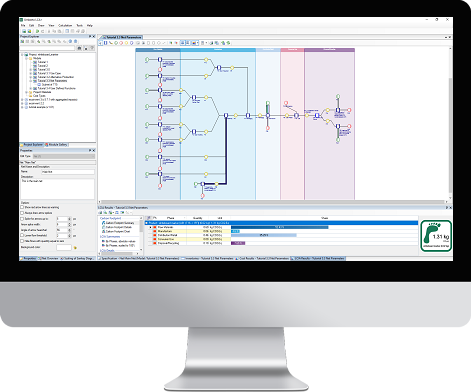
Model complex product systems, manage comprehensive environmental data, and generate ISO-compliant assessments with iPoint's proven LCA platform.

IPOINT's Umberto LCA Software provides comprehensive functionality:
- Visual flow modeling for material and energy streams
- Built-in databases for background processes
- ISO 14040/14044 compliance
- Integration with Product Carbon Footprint and Environmental Product Declaration workflows
Our professional LCA software streamlines data collection, enables systematic hotspot identification, and generates audit-ready documentation. Scalability supports growing assessment programs from initial pilots through portfolio-wide implementation.
Integration with Sustainability Strategies
Life cycle assessments deliver maximum value when integrated into broader sustainability programs rather than existing as isolated compliance exercises. Organizations that embed LCA insights into strategic decision-making gain competitive advantages through data-driven environmental improvements.
Strategic integration opportunities span multiple initiatives:
- Product Carbon Footprint calculations quantify greenhouse gas emissions across life cycle stages for carbon neutrality strategies.
- Environmental Product Declarations communicate verified environmental performance to procurement decision-makers and green building certification programs.
- Circular economy initiatives require end-of-life modeling to quantify recycling benefits and design for material recovery.
- ESG reporting frameworks increasingly demand Scope 3 emissions data covering upstream and downstream value chain activities.
From assessment to action: Hotspot analysis directs improvement resources toward high-impact opportunities rather than marginal gains. Scenario modeling evaluates design alternatives before committing to costly product changes. Supplier collaboration addresses upstream impacts through data-driven engagement backed by specific environmental metrics.
Life cycle thinking supports regulatory compliance spanning Product Environmental Footprint methodologies, Ecodesign requirements, and emerging due diligence obligations under EU sustainability legislation.