
Twenty-eight days. That's how long it took to cross two oceans on a cargo ship, tucked in alongside five thousand tons of kiwifruit on their way from New Zealand to Europe. Sixteen days from New Zealand's North Island to Panama, twelve more from Panama through the Atlantic and into the English Channel. No entertainment program, no shore excursions, just the low, steady hum of a two-stroke diesel engine that never really stops.
- Shipping Carbon Footprint: Key Facts at a Glance
- What Counts as a Shipping Carbon Footprint?
- How Much CO₂ Does a Cargo Ship Really Emit?
- Heavy Fuel Oil Emissions and the IMO 2020 Sulphur Cap
- The Shipping Emissions Regulatory Landscape in 2026
- Turning Shipping Data into Scope 3 Advantage
- FAQ
Shipping Carbon Footprint: Key Facts at a Glance
-
Carbon intensity: Ocean freight produces roughly 10 to 20 grams of CO₂e per tonne-kilometer, still the lowest carbon intensity of any major freight mode.
-
A shared calculation standard: ISO 14083:2023 and the GLEC Framework now give companies a shared, auditable method for calculating transport emissions.
-
Carbon pricing has arrived: The EU ETS has covered shipping since 2024 and reached 100% of verified emissions from January 2026; FuelEU Maritime adds a separate, tightening fuel-intensity limit since 2025.
-
Where it sits on the books: For most companies, ocean freight emissions fall under Scope 3, Categories 4 and 9: upstream and downstream transportation and distribution.
That trip got written up once before, back when "freighter travel" was still a curiosity you'd bring up at parties rather than a line item in a sustainability report. The question hasn't really changed, just gained sharper regulatory teeth: how much carbon does it actually take to move cargo across an ocean, and how does that compare to the alternatives?
The short answer hasn't changed either: ton for ton, ocean freight is still the most carbon-efficient way to move goods over long distances. What has changed is everything around that fact. There's now a global standard for calculating it (ISO 14083), a rapidly tightening set of EU and IMO rules that price it, and a name for where it sits on the books: Scope 3.
What Counts as a Shipping Carbon Footprint?
A shipping carbon footprint measures the greenhouse gas emissions generated by moving goods by sea, from the fuel a vessel burns to the reefer units keeping perishable cargo cold in transit. For most companies it never stands alone. It's one piece of a much larger Scope 3 inventory.
Under the GHG Protocol, ocean freight typically lands in Category 4 (upstream transportation and distribution) if a company pays for the inbound leg, or Category 9 (downstream) if customers handle it after the point of sale. Either way, it's transportation performed by a third party, so it counts as Scope 3, not Scope 1. For the full breakdown, the Scope 1, 2, and 3 Emissions Guide walks through each category in detail. At the product level, the same emissions feed into a Product Carbon Footprint (PCF). Rolled up across a supplier base, they become the transportation slice of a Corporate Carbon Footprint (CCF).
How Much CO₂ Does a Cargo Ship Really Emit?
Back in 2013, the go-to comparison came from a single trade association: 15 g of CO₂ per tonne-kilometer for container ships, versus 35 g for rail, 50 g for trucks, and 540 g for air cargo. Good for a magazine sidebar, not something anyone could hand to an auditor.
That's the gap ISO 14083:2023 and the GLEC Framework, maintained by the Smart Freight Centre, were built to close: a common calculation method with a hierarchy of data quality, from a carrier's actual metered fuel consumption down to sector-average defaults. Based on that methodology, the broad picture still holds:
| Transport Mode | Typical Emissions (g CO₂e per Tonne-km, Well-to-Wake) |
|---|---|
| Deep-sea container ship | ~10–20 |
| Rail freight (mixed diesel/electric) | ~20–30 |
| Heavy goods vehicle (truck) | ~60–120 |
| Air freight | ~500–1,200+ |
These are ranges on purpose: a half-empty vessel or a short feeder route can shift the real number substantially, which is exactly why ISO 14083 asks for primary carrier data wherever it's available. What hasn't moved is the order of magnitude: air freight remains roughly 20 to 50 times more carbon-intensive than ocean freight per tonne-kilometer, which is why modal shift is usually the biggest lever in any transportation decarbonization plan. None of this makes ocean freight "clean." It makes it the least-bad option for moving heavy cargo over long distances, a different claim, and one worth being precise about in a Scope 3 disclosure.
Heavy Fuel Oil Emissions and the IMO 2020 Sulphur Cap
Most of that low per-tonne figure comes down to one unglamorous fact: large ships still overwhelmingly run on heavy fuel oil, the thick, high-sulfur residue left over once refineries pull the cleaner fractions out of crude oil for cars, planes, and heating. It's cheap, energy-dense, and, until recently, largely unregulated on the open ocean.
That changed with "IMO 2020." Since January 1, 2020, the global sulfur limit for marine fuel has been capped at 0.5% mass by mass, down from 3.5%, with a stricter 0.1% limit inside Emission Control Areas like the Baltic and North Sea. According to the IMO, that cut total sulfur oxide emissions from shipping by roughly 70% in its first year.
Shipowners comply either by switching to very-low-sulfur fuel oil or by installing scrubbers that strip sulfur from the exhaust while still burning cheap heavy fuel oil. Around 16% of the global fleet now sails with scrubbers fitted. Here's the nuance worth knowing for anyone reporting heavy fuel oil emissions: neither path is a decarbonization strategy. Independent analysis by CE Delft found scrubbers add about 1.5 to 3% more CO₂, while refining low-sulfur fuel without a scrubber tends to add more, 1% to 25%, depending on the crude and refinery. Solving the sulfur problem doesn't solve the carbon one, and that gap is exactly what the next generation of shipping regulation targets.
The Shipping Emissions Regulatory Landscape in 2026
Carbon is now dominating the agenda through several overlapping measures worth tracking.
IMO Carbon Intensity Indicator (CII). Since 2023, ships over 5,000 gross tonnage have calculated an annual operational rating from A to E, with the bar rising roughly 2% a year toward the IMO's target of a 40% cut in carbon intensity by 2030 against a 2008 baseline. A ship rated D for three years running, or E even once, must file a corrective action plan. There's no direct IMO fine, but charterers, banks, and insurers increasingly build CII into contracts and financing, so it already shapes which vessels carry a given shipment.
EU ETS for shipping. The EU Emissions Trading System has applied to ships of 5,000 GT and above since 2024, phased in at 40% of verified emissions that year and 70% in 2025. As of January 1, 2026, shipping companies must surrender allowances for 100% of verified emissions, now including methane and nitrous oxide alongside CO₂. Non-compliance carries a penalty of roughly €100 per tonne of CO₂-equivalent, on top of still owing the allowances.
FuelEU Maritime. Where the EU ETS prices what a ship emits, this regulation, in force since January 2025, limits the carbon intensity of the fuel itself, measured well-to-wake. Against a 2020 baseline of 91.16 gCO₂e/MJ, the required cut runs 2% from 2025, 6% from 2030, 14.5% from 2035, and up to 80% by 2050, with a roughly €2,400-per-tonne penalty for missing the target.
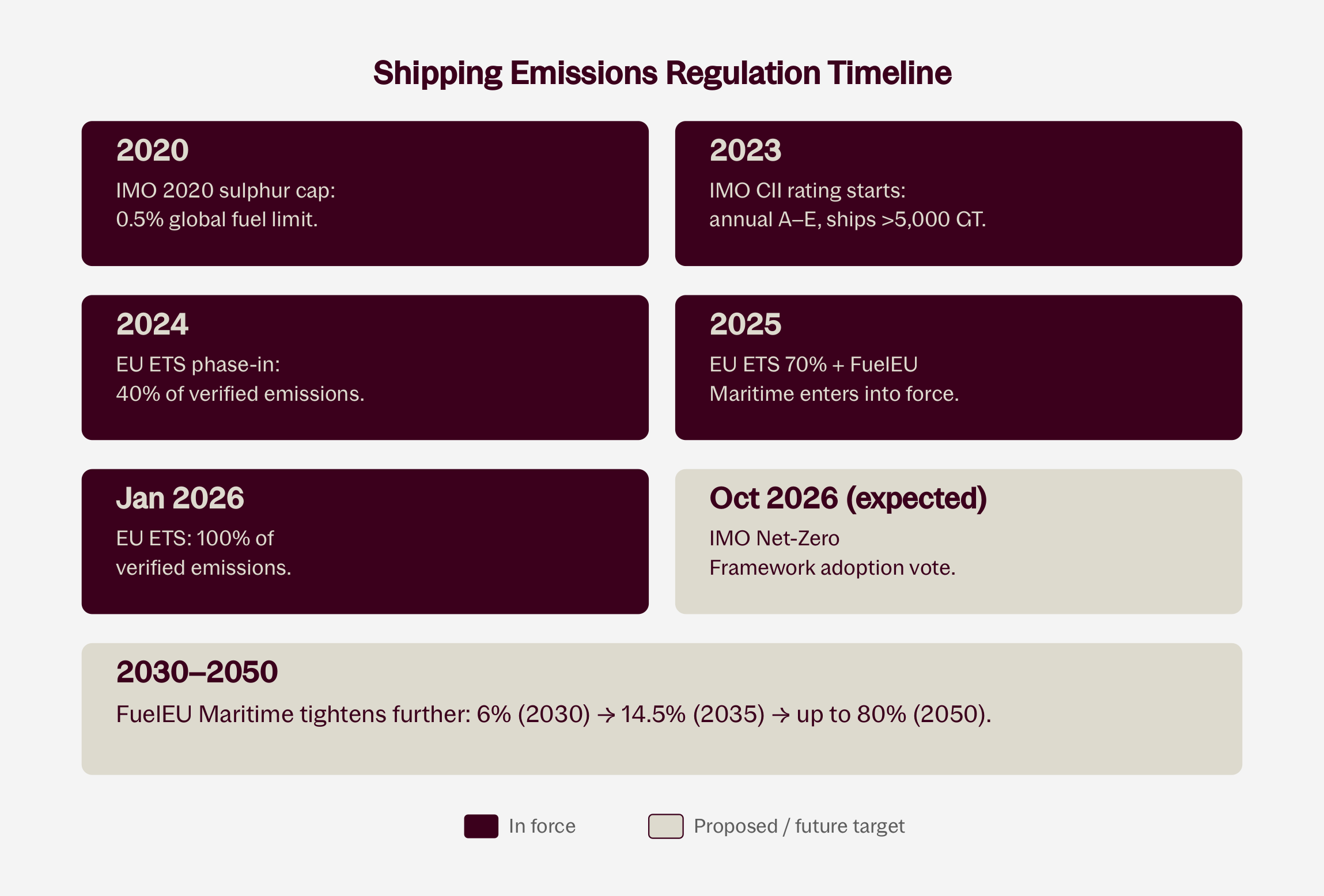
Shipping emissions regulation from the IMO 2020 sulphur cap to full EU ETS coverage and the tightening FuelEU Maritime fuel-intensity limit.
One global measure isn't in force yet: the IMO's proposed Net-Zero Framework, combining a fuel-intensity standard with carbon pricing, was provisionally agreed upon in April 2025, but its formal adoption vote was postponed a year after strong opposition led by the United States. A new vote is expected around October 2026. Until then, the EU rules above remain the binding framework for any shipping emissions tied to European trade.
Turning Shipping Data into Scope 3 Advantage
For sustainability and supply chain managers, the practical work is turning carrier data into something that holds up in a CSRD-ready sustainability statement. A few principles matter most:
-
Primary carrier data beats generic averages. A named vessel's actual fuel consumption, matched by IMO number, is a Tier 1 input under ISO 14083; a blanket "ocean freight" factor is a last resort, not a starting point.
-
CSRD doesn't let transportation hide. Under ESRS E1, material Scope 3 categories, transportation included, must be reported or their exclusion justified. The CSRD & Scope 3 guide covers what "material" means in practice.
Ready to Put a Number on Your Shipping Emissions?
IPOINT's Carbon Footprint software calculates Product and Corporate Carbon Footprints in line with ISO 14064, ISO 14067, PAS 2050, and the GHG Protocol, so transportation emissions like these stop being a rough estimate and start being audit-ready data.

Frequently Asked Questions
What is a shipping carbon footprint?
A shipping carbon footprint is the total greenhouse gas emissions generated by moving goods by sea, covering fuel combustion, onboard energy use, and the resulting CO₂, methane, and nitrous oxide. For most companies, it counts as Scope 3, Category 4 or 9 of the GHG Protocol.
How much CO₂ does a cargo ship emit per tonne-kilometer?
Based on GLEC Framework and ISO 14083-aligned estimates, large deep-sea container ships typically emit around 10 to 20 grams of CO₂e per tonne-kilometer, well-to-wake, depending heavily on vessel size, fuel, and load factor.
What is ISO 14083, and how does the GLEC Framework relate to it?
ISO 14083:2023 is the international standard for quantifying transport chain emissions across all modes. The GLEC Framework, developed by the Smart Freight Centre, formed the basis for it and remains the practical guideline most companies use to apply it.
Do companies need to report shipping emissions under CSRD?
If transportation emissions are material to a company's Scope 3 footprint, which is the case for most manufacturers, retailers, and logistics-heavy businesses, they need to be included under ESRS E1, or their exclusion clearly justified.