
Social Life Cycle Assessment (S-LCA) evaluates the social and socio-economic impacts of a product or service across its entire life cycle, from raw material extraction to end of life. For over a decade, the field relied entirely on voluntary guidance. That changed in October 2024, when ISO published ISO 14075, the first international standard for social life cycle assessment.
This guide explains what Social LCA covers, how ISO 14075 builds on the earlier UNEP/SETAC Guidelines, how the PSILCA database supports social hotspot screening, and why S-LCA data increasingly matters for ESRS and CSDDD compliance.
- Social LCA: Key Facts at a Glance
- How Does S-LCA Differ from Environmental LCA?
- From Voluntary Guidelines to ISO 14075: A Brief History
- PSILCA: The Leading Social Hotspots Database
- Why Social LCA Matters for ESRS and CSDDD Compliance
- How to Conduct a Social Life Cycle Assessment
- From Compliance to Strategy
- FAQ
Social LCA: Key Facts at a Glance
-
What it is: Social Life Cycle Assessment (Social LCA, S-LCA, occasionally social life cycle analysis) assesses how a product's life cycle affects workers, local communities, value chain actors, society, and consumers.
-
The new standard: ISO 14075:2024, published in October 2024, is the first international standard for S-LCA.
-
The predecessor: Before ISO 14075, S-LCA relied on the voluntary UNEP/SETAC Guidelines for Social Life Cycle Assessment (2009, updated 2020).
-
The leading database: PSILCA, developed by GreenDelta, is the most widely used social hotspots database. Version 4.0.1 was released in January 2026.
-
Why it matters now: S-LCA data increasingly underpins the social disclosures required under the ESRS (S1–S4) and the due diligence obligations under the CSDDD.
How Does S-LCA Differ from Environmental LCA?
S-LCA applies the same life cycle thinking as environmental LCA but points it at people instead of ecosystems. Both methodologies follow a four-phase structure: goal and scope definition, inventory analysis, impact assessment, and interpretation. Where environmental LCA impact categories quantify effects such as climate change, resource depletion, or eutrophication, S-LCA assesses social and socio-economic conditions instead.
S-LCA organizes these conditions around stakeholder categories. The UNEP/SETAC Guidelines define six: workers, value chain actors (such as suppliers), local communities, society, consumers, and children, the last added in the 2020 update to represent the interests of future generations. For each stakeholder group, practitioners assess a set of social subcategories using qualitative and quantitative indicators.
| Stakeholder Category | Example Topics Assessed |
|---|---|
| Workers | Fair wages, working hours, health and safety, freedom of association |
| Value chain actors | Fair competition, supplier relationships, respect for intellectual property |
| Local communities | Community engagement, access to resources, cultural heritage |
| Society | Public commitments to sustainability, contribution to economic development |
| Consumers | Health and safety, transparency, data privacy |
| Children | Child labor, access to education |
From Voluntary Guidelines to ISO 14075: A Brief History
Social LCA has existed as a formal methodology since 2009, when the UNEP/SETAC Life Cycle Initiative published its first Guidelines for Social Life Cycle Assessment of Products. That first version introduced five stakeholder categories and an initial set of methodological sheets to help practitioners select and apply social indicators. A 2020 update added the sixth stakeholder category, children, and expanded the methodological sheets.
Throughout this period, S-LCA remained guidance rather than a standard: widely cited and genuinely useful, but voluntary, and without the formal consensus process or conformity language of an ISO standard.
That changed in October 2024. ISO published ISO 14075, Environmental management — Principles and framework for social life cycle assessment, the first international standard dedicated to S-LCA. Working Group 15 of ISO/TC 207/SC 5 developed the standard over roughly three years, running several rounds of global stakeholder consultation that each drew hundreds of comments. ISO 14075 sets out principles, requirements, and guidance for the goal and scope definition, inventory analysis, impact assessment, interpretation, and reporting of an S-LCA, and frames the methodology as a tool to support the UN Sustainable Development Goals by distinguishing a product's enabling social contributions from its detrimental ones.
| Aspect | UNEP/SETAC Guidelines (2009/2020) | ISO 14075 (2024) |
|---|---|---|
| Status | Voluntary guidance | Formal international standard |
| Stakeholder categories | 5 in 2009, expanded to 6 (adding children) in 2020 | Builds on the UNEP/SETAC categories |
| Developed by | UNEP Life Cycle Initiative, expert-led | ISO/TC 207/SC 5, Working Group 15, multi-stakeholder consensus |
| Practical role | Foundational methodology and indicator sheets | Auditable, benchmarkable framework for goal/scope, inventory, impact assessment, interpretation, and reporting |
For sustainability managers, the practical difference matters. An S-LCA that follows ISO 14075 can be benchmarked, audited, and communicated against a recognized international standard, much as ISO 14040 and ISO 14044 anchor environmental LCA, rather than resting solely on voluntary guidance open to interpretation.
PSILCA: The Leading Social Hotspots Database
Collecting site-specific primary data for every tier of a global supply chain is rarely realistic. Social hotspots databases fill that gap: they provide generic, sector- and country-level social risk data that let practitioners screen a product system quickly and direct limited resources toward the areas of highest risk.
PSILCA (Product Social Impact Life Cycle Assessment), developed by GreenDelta, is the most widely used database of this kind. It covers close to 15,000 industry sectors and commodities across the global economy, with 106 qualitative and quantitative indicators spanning the six S-LCA stakeholder categories. Each indicator comes as a risk-assessed elementary flow with a documented data source, so results feed directly into S-LCA software such as openLCA.
GreenDelta released PSILCA v4.0.1 in January 2026 as the current version. It refines the "contribution to economic development" indicator and its calculation script, building on the broader v4.0 update, which added 41 new indicators and improved source data across the board. PSILCA is available through openLCA Nexus in three tiers, Starter, Professional, and Developer, with the higher tiers exposing raw indicator values and greater methodological transparency.
Mineral extraction is a good illustration of what hotspot screening turns up. Tin, tantalum, tungsten, gold, cobalt, and mica consistently register as high-risk sectors for forced labor, child labor, and unsafe working conditions, which is why responsible minerals sourcing already has its own due diligence track record separate from S-LCA. A PSILCA-based screening will flag the same sectors, which makes mineral supply chains a natural starting point for a first S-LCA hotspot analysis.
In practice, most robust S-LCAs combine PSILCA-style background data for hotspot screening with targeted, site-specific data collection wherever screening flags elevated social risk, an approach fully consistent with the goal-and-scope and inventory-analysis phases of ISO 14075.
Why Social LCA Matters for ESRS and CSDDD Compliance
Two regulatory developments have pushed social impact data from a specialist sustainability topic into a compliance requirement.
The European Sustainability Reporting Standards (ESRS), issued under the CSRD, include four social standards: S1 (Own Workforce), S2 (Workers in the Value Chain), S3 (Affected Communities), and S4 (Consumers and End-users). Companies in scope must assess and disclose against these standards under the principle of double materiality, covering both their impact on people and the financial relevance of social risks. The ongoing ESRS simplification reduces the number of mandatory datapoints, but the four social standards and the double materiality requirement itself remain in place.
The Corporate Sustainability Due Diligence Directive (CSDDD) goes further: in-scope companies must actively identify, prevent, and address adverse human rights and environmental impacts across their chain of activities, rather than only reporting on them. Germany's Supply Chain Due Diligence Act (LkSG) imposes comparable obligations at a lower company-size threshold and will eventually be replaced by national legislation implementing the CSDDD.
For sustainability and compliance teams, data is the common thread. ESRS S1–S4 disclosures and CSDDD due diligence assessments both need credible, stakeholder-specific evidence on labor conditions, community impacts, and human rights risks across the value chain, which is exactly what a structured S-LCA, backed by a database such as PSILCA and grounded in ISO 14075, is designed to produce. Companies that build a solid S-LCA capability can generally draw on the same underlying evidence base for both reporting and due diligence, rather than running separate data efforts for each.
How to Conduct a Social Life Cycle Assessment
ISO 14075 structures an S-LCA around four phases, mirroring the established environmental LCA framework:
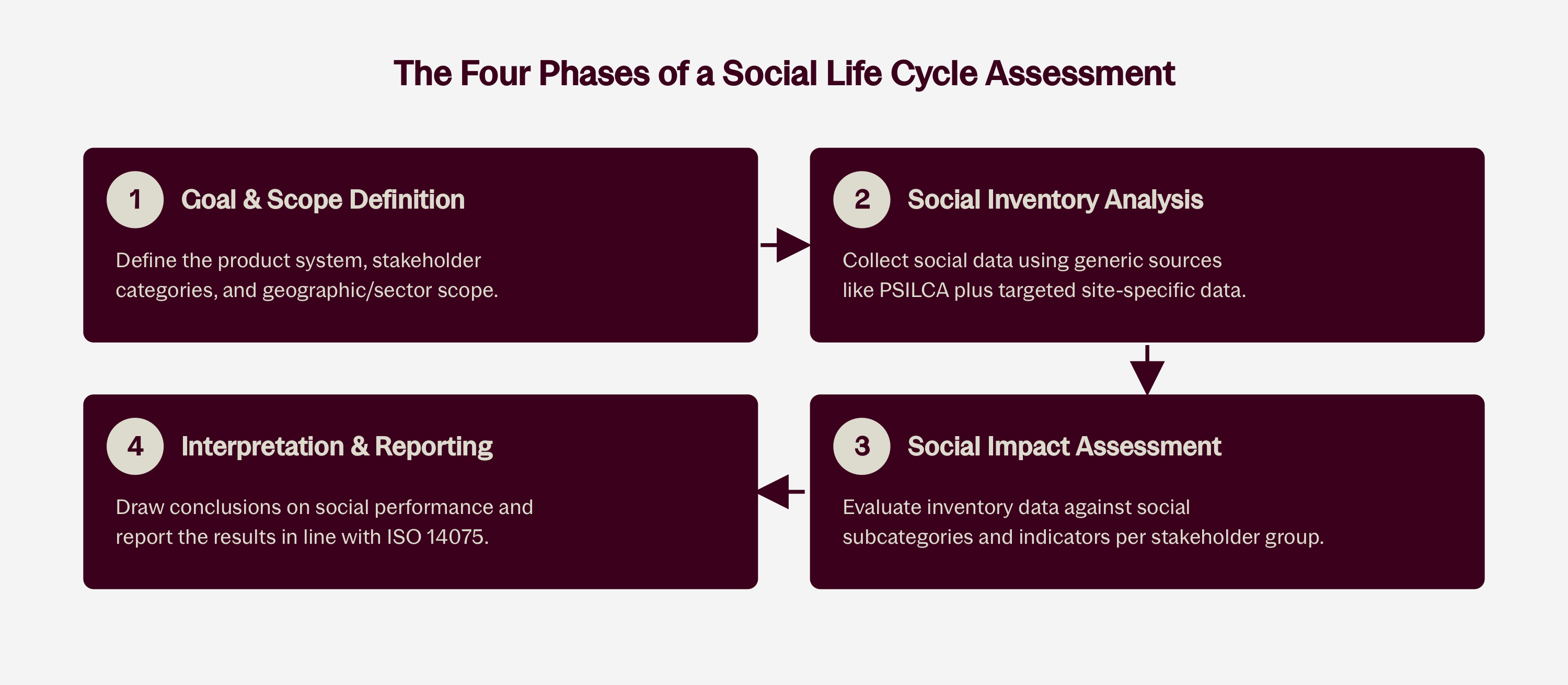
The four ISO 14075 phases of a Social Life Cycle Assessment, from goal and scope definition to interpretation and reporting.
From Compliance to Strategy
Companies that treat Social LCA as a box to check for ESRS or CSDDD purposes tend to collect the data once, report it, and repeat the exercise the following year with limited additional insight. Companies that treat S-LCA as a genuine risk management and product design tool get more out of the same hotspot data. Sourced from a database like PSILCA and structured against ISO 14075, it informs supplier selection, prioritizes corrective action in the supply chain, and backs sustainability claims with standardized evidence instead of ad-hoc assurances. As ESRS and CSDDD obligations phase in over the coming years, sustainability teams that already hold this data will have a considerable head start over those still building it from scratch.
IPOINT's Human Rights and Responsible Sourcing solutions help turn hotspot findings into ongoing supplier monitoring, while the same underlying data feeds ESRS- and CSDDD-aligned sustainability steering.
Turn Social Impact Data Into Strategic Advantage
See how leading companies move from compliance to data-driven sustainability steering, using a structured six-step framework.

Frequently Asked Questions
What is the difference between S-LCA and environmental LCA?
Both follow the same four-phase life cycle assessment structure, but they measure different things. Environmental LCA, governed by ISO 14040 and ISO 14044, quantifies impacts such as climate change, resource use, or emissions. S-LCA, governed by ISO 14075, assesses social and socio-economic impacts on workers, communities, consumers, and other stakeholders.
Is ISO 14075 mandatory?
No. ISO 14075 is a voluntary international standard, not a legal requirement. Companies apply it to make their S-LCA studies more credible, comparable, and auditable, including when that data feeds into disclosures under frameworks like the ESRS.
Do I need PSILCA, or can I collect my own data?
Most S-LCA studies use both. Site-specific primary data gives the most accurate picture but is not feasible for every tier of a global supply chain. Generic databases like PSILCA close the gaps and help identify where site-specific data collection is worth the effort.
Is Social LCA only relevant for companies in scope of the CSDDD or CSRD?
No. While the CSDDD and ESRS have raised the profile of social impact data, companies also use S-LCA voluntarily in response to customer, investor, or NGO scrutiny of their supply chains, or to get ahead of due diligence requirements that may reach them indirectly through larger customers.